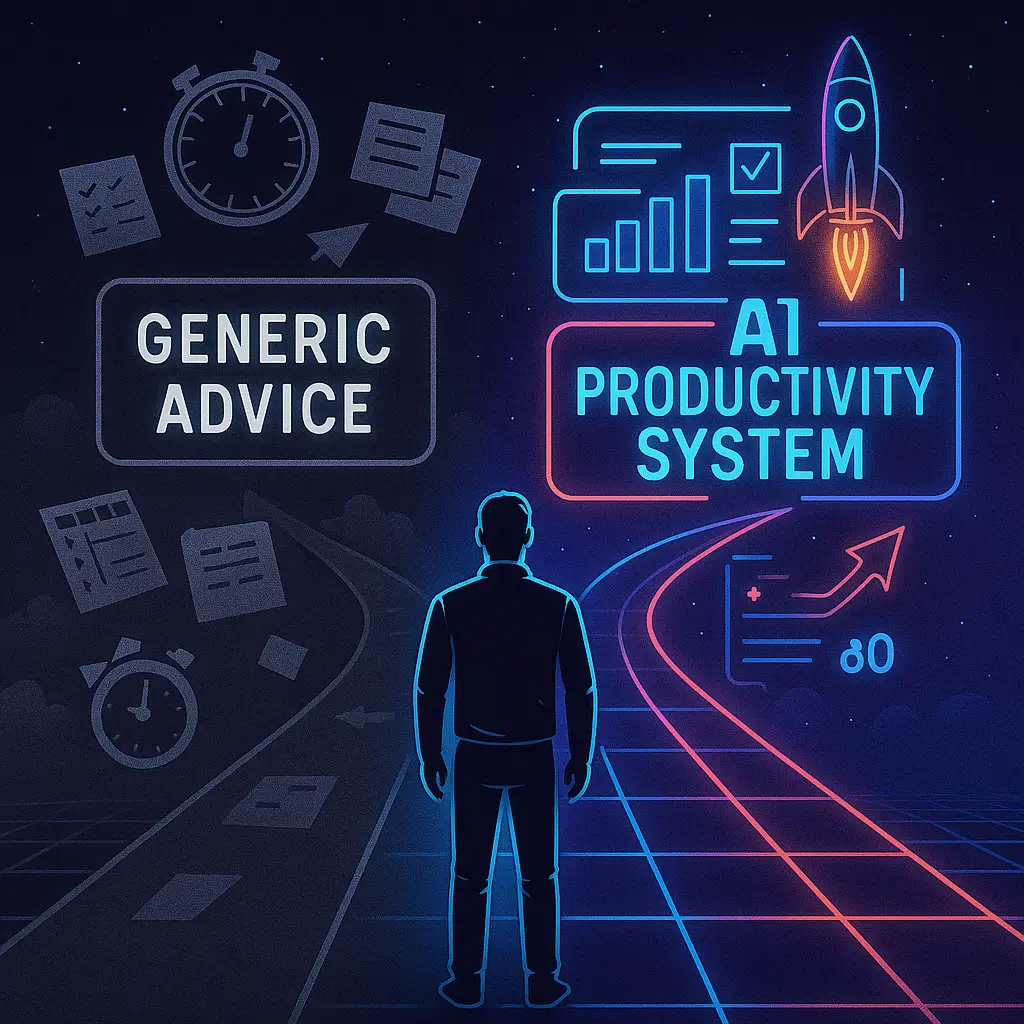
Quick answer: How to be productive comes down to three moves: find the hours when your focus naturally peaks, set up your environment so the right task is the easiest one to start, and make progress rewarding enough that you want to repeat it. AI speeds this up by spotting your personal patterns and turning them into a plan built for your brain.
I’ll never forget sitting in my college dorm, surrounded by highlighters and the latest productivity systems everyone swore would change my life. The Pomodoro Technique. Time blocking. Bullet journaling.
Every single one failed me within a week.
It wasn’t because I lacked discipline. It was because I have ADHD, and my brain doesn’t work the way those generic systems assume everyone’s brain works. Then I discovered the Pareto Principle, the 80/20 rule. Instead of trying to do everything the “right” way, I asked: “What’s MY 20% that will produce 80% of my results?” My grades shot up. I graduated with honors. And I eventually built and sold a company for $323 million using these same personalized productivity principles.
The real question isn’t just how to be productive. It’s how to be productive in a way that works for YOU.
Being productive isn’t about squeezing more tasks into your day. To be productive over the long run, you need a system that identifies YOUR specific blockers, builds productivity habits around your real context, and keeps you accountable in a way that feels like a game instead of a grind. AI is very good at all three.
What AI-Powered Productivity Unlocks
🤖 Discover your productivity pattern: AI identifies when you focus best and what drains your energy, so you stop guessing and stop fighting your natural rhythms.
⚡ Get personalized Golden Habits: Custom strategies for home, work, and ADHD that stick because they’re designed around YOUR life, not someone else’s.
🎮 Gamified accountability: Productivity becomes a rewarding game instead of an exhausting grind. You get healthy dopamine hits that fuel progress instead of scrolling.
Why Generic Productivity Advice Fails (And Why You’re Not Broken)
Here’s the truth nobody tells you: one-size-fits-all productivity tips ignore the most important variable, which is YOU.
Viral challenges like “wake up at 5am” or “check email only twice a day” work brilliantly for some people and crash spectacularly for others. Procrastination and distraction have different root causes for different people. What works for a neurotypical morning person won’t work for someone with ADHD who hits peak focus at 10pm.
The research backs this up. A University College London study published in the European Journal of Social Psychology found that forming a new habit took an average of 66 days, with individual results ranging from 18 to 254 days. Same goal, wildly different timelines. (We break down the latest research in how many days it really takes to make a habit.)
The workplace makes it harder. Microsoft’s 2023 Work Trend Index found that 68% of people say they don’t have enough uninterrupted focus time during the workday. The problem isn’t just willpower. It’s how our days are structured.
You keep failing not because you’re undisciplined, but because the advice doesn’t account for:
- Your unique energy patterns (are you really a morning person, or just following advice?)
- Your specific environment (home office with kids vs. quiet corporate office)
- Your brain wiring (ADHD, anxiety, high sensitivity, autism spectrum)
- Your actual motivation drivers (what genuinely excites YOU, not what should)
Discipline still matters, but it works best when your system does most of the heavy lifting. (More on that in how to build discipline and consistency.) So the answer to how to be more productive depends entirely on your context. That’s where AI changes the game.
| Generic productivity advice | AI-personalized approach | |
|---|---|---|
| Schedule | “Wake up at 5am” | Work blocks mapped to YOUR peak focus hours |
| Focus method | Fixed 25-minute Pomodoros | Sprint length based on your attention patterns |
| Environment | “Eliminate distractions” | Specific fixes for your home or office triggers |
| Planning | Same template every day | Daily plan adjusted to your energy and interruptions |
| Motivation | Willpower and discipline | Gamified rewards tied to your goals |
| ADHD fit | Usually ignored | Built around novelty, interest, and hyperfocus |
How to Be Productive With AI: The 7-Step Framework
AI can analyze your patterns, identify what works for people like you, and turn it into a personalized system. Here’s the framework:
- Discover your productivity pattern so you know when and how you focus best.
- Build around your brain, especially if you have ADHD.
- Design your home environment so focus is the default.
- Protect deep work at the office from meetings and interruptions.
- Remove friction so good habits take less effort than bad ones.
- Plan each day around your energy, not a generic template.
- Gamify your progress so you actually want to keep going.
1. Discover Your Productivity Pattern With AI
Before you can be productive, you need to understand YOUR unique productivity DNA. AI excels at pattern recognition. It can analyze when you reach peak focus, what triggers your biggest distractions, and which tasks you naturally procrastinate on.
Traditional advice tells you to “eat the frog” and tackle your hardest task first thing in the morning. But what if your brain doesn’t fully wake up until 11am? What if you need creative warm-up tasks before diving into analytical work? Generic advice won’t tell you this. AI will.
🤖 AI PROMPT TO COPY/PASTE:
I want to understand my productivity pattern. Ask me 10 questions about:
1. When I feel most focused during the day
2. What typically distracts me
3. Tasks I tend to procrastinate on
4. My work environment (home, office, hybrid)
5. Any conditions that affect my focus (ADHD, anxiety, etc.)

After my responses, identify my unique productivity pattern and suggest my '20%'—the few high-impact actions that will produce 80% of my results.
What to expect from AI:
- Your personalized productivity profile (morning achiever, afternoon creator, evening analyst, etc.)
- Your peak performance windows mapped to specific times
- Your top 3 productivity blockers with root-cause analysis
- Your “Golden Productivity Habits,” the specific habits that will work for YOUR brain
This approach is based on the Pareto Principle that turned my ADHD from a curse into a superpower. Instead of trying to fix every weakness, focus on the 20% that produces 80% of your results. AI helps you identify exactly what that 20% is, which eliminates decision fatigue about what to work on.
2. How to Be Productive With ADHD: Work With Your Brain, Not Against It
How to be productive with ADHD starts with dropping the idea that you need a neurotypical system. ADHD brains are interest-driven and novelty-seeking. The best approach uses short work sprints, external accountability, and tasks matched to what genuinely grabs your attention.
Common ADHD productivity challenges include:
- Executive function difficulties (starting tasks feels impossible)
- Hyperfocus vs. scattered attention (all or nothing)
- Time blindness (where did 3 hours go?)
- Rejection sensitivity affecting motivation (avoiding tasks that might lead to criticism)
Traditional advice says “just eliminate distractions.” For ADHD brains, that’s like telling someone to “just be taller.” The ADHD brain craves novelty and stimulation. Removing all stimulation doesn’t increase focus. It increases restlessness. (For more tactics, see our guide on how to focus with ADHD.)
AI personalization for ADHD brains looks different:
- Shorter work sprints during your peak dopamine windows (not arbitrary 25-minute Pomodoros)
- Novelty-based task rotation (switching tasks strategically, not randomly)
- External accountability prompts timed to YOUR distraction patterns
- Interest-based planning instead of importance-based planning (ADHD brains can’t force interest)
🤖 AI PROMPT FOR ADHD PRODUCTIVITY:
I have ADHD and struggle with [starting tasks/maintaining focus/time blindness/etc.]. Help me design a productivity system that works WITH my ADHD brain, not against it. Consider:
- My hyperfocus triggers (what captures my attention naturally)
- When my medication is most effective (if applicable)
- Tasks that drain vs. energize me
- My need for novelty and stimulation

Create a daily structure with built-in breaks, dopamine rewards, and flexibility for hyperfocus sessions when they happen.
This is exactly how I went from struggling college student to honors graduate. I stopped fighting my ADHD and started leveraging it. When I discovered I could hyperfocus on creative problem-solving for hours, I scheduled my toughest analytical work during those windows. When I learned my medication was most effective from 10am to 2pm, I protected that time fiercely.
⚠️ Health note: This section shares personal experience and general strategies, not medical advice. ADHD is a medical condition, and medication timing and dosing differ from person to person. Talk to your doctor or prescriber before changing your treatment or building a schedule around it. For evidence-based support, CHADD is a good starting point.
AI helps identify YOUR unique ADHD strengths and designs around them instead of treating ADHD as something to overcome.
Read More: How to Be Productive with ADHD: 7 Science-Backed Habits
3. How to Be Productive at Home: Make Focus the Obvious Choice
How to be productive at home comes down to separating work cues from rest cues. Your home mixes both in the same space, so you need a dedicated focus zone, a clear “work mode” signal, and boundaries your household understands.
James Clear put it perfectly in Atomic Habits: “You do not rise to the level of your goals. You fall to the level of your systems.” Environment design beats willpower every single time.
Home can actually be a productivity advantage. In a randomized experiment led by Stanford economist Nicholas Bloom, call-center employees at the travel company Ctrip who worked from home for nine months improved their performance by 13%, partly thanks to a quieter working environment. The setup matters more than the location.
AI environmental analysis looks at your physical and digital spaces for productivity triggers and distraction sources you might not notice. It’s like having a productivity detective who spots the hidden obstacles sabotaging your focus.
For example, AI might notice: “You lose 90 minutes daily to phone checking. Your phone is visible on your desk during focus time. Moving it to a drawer from 9 to 11am would remove most of these interruptions without requiring willpower.” (If your phone is the main culprit, try these healthy digital habits.)
AI strategies for home productivity:
- Create separate zones for focus and rest (even in small spaces, a specific chair or desk position works)
- Design visual cues for “work mode” (a specific lamp on, dedicated headphones)
- Eliminate domestic distraction triggers (kitchen within eyesight, TV nearby, comfortable couch)
- Generate family boundary scripts (“When my office door is closed until 2pm, I’m in deep work mode”)
🤖 AI PROMPT FOR HOME PRODUCTIVITY:
I work from home and struggle with [household distractions/maintaining boundaries/separating work and rest spaces]. Analyze my home environment and create a setup that makes productivity the path of least resistance. Include:
- Visual cues that signal "work mode" to my brain and family
- Boundary strategies for roommates/family/pets
- Environmental triggers that help me start and stop work cleanly
4. How to Be More Productive at Work: Protect Your Deep Work
How to be more productive at work? Protect a daily deep-work block during your peak energy, batch email and messages into set windows, and consolidate meetings. The biggest workplace productivity killer isn’t laziness. It’s constant interruption.
The numbers are striking. Microsoft’s research on the “infinite workday” found that employees using Microsoft 365 are interrupted every 2 minutes, on average, by a meeting, email, or notification. And in an interview with Gallup, UC Irvine researcher Gloria Mark explained that interrupted work took about 23 minutes on average to resume, usually after two other tasks in between.
AI is also proving to be a real productivity tool at work. In a field experiment by Harvard Business School and Boston Consulting Group with 758 consultants, those using GPT-4 completed 12.2% more tasks and worked 25.1% faster, with significantly higher-quality results on tasks suited to AI. The catch: on a task outside AI’s strengths, consultants using AI were 19% less likely to get the right answer. That’s why a personalized system beats blindly using AI for everything.
AI strategies for office productivity:
- Digital environment optimization (notification rules, email batching, Slack focus mode)
- Social boundary scripts (“I’m in deep work mode until lunch. Can we talk at 1pm?”). If saying this feels uncomfortable, see how to start a hard conversation with the help of AI.
- Meeting consolidation (AI can suggest moving meetings to specific days or times)
- Deep work blocks during your peak energy (AI can help you decline invites that clash with your power hours)
Pro tip: AI can draft your calendar “focus time” blocks and even write polite decline messages for meeting invites that conflict with your peak productivity windows. No awkwardness, no guilt, just protected time.
Read More: 15 Productivity Tips for Work That Actually Stick
5. Make It Easy: Use AI to Remove Friction
BJ Fogg’s Behavior Model changed how we understand habits: B = MAP. Behavior happens when Motivation, Ability, and a Prompt come together. His core insight is that when a behavior is easy enough, you barely need motivation to do it.
AI friction analysis spots hidden obstacles in your routine that you’ve gone blind to. Maybe you say you’ll meal prep on Sundays, but AI notices you’re consistently exhausted on Sundays. The friction isn’t willpower. It’s timing.
AI friction reduction strategies:
- Identifies natural habit-stacking opportunities in YOUR existing routine
- Creates Minimal Viable Action (MVA) versions of intimidating tasks
- Automates decision points that drain mental energy
- Suggests process improvements based on your actual behavior, not your ideal behavior
Habit stacking is particularly powerful, and it’s backed by solid science. A meta-analysis of 94 independent studies by Peter Gollwitzer and Paschal Sheeran found that “if-then” plans had a medium-to-large positive effect on reaching goals. Instead of relying on motivation or memory, you attach new habits to existing ones. Example: “After I pour my morning coffee, I’ll review my top 3 priorities.”
AI finds YOUR natural transition points, the moments when habit stacking will actually work instead of adding more mental load.
Read More: ADHD Habit Stacking
6. How to Plan Your Day to Be Productive
Most people use the same planning template every day and ignore their natural energy curve. AI creates dynamic daily plans based on your actual patterns.
AI-powered daily planning includes:
- Time blocking matched to your energy curve (creative work when creative energy peaks, admin when it dips)
- Realistic task estimation (AI learns YOUR pace, not the average pace)
- Buffer time for unexpected tasks (based on your interruption patterns)
- Evening reflection prompts that help you improve tomorrow’s plan
🤖 AI DAILY PLANNING PROMPT:
Help me plan tomorrow for maximum productivity. I have [X hours] available, my peak focus is [morning/afternoon/evening], and I need to complete [list tasks]. Consider my energy patterns and suggest:
1. Time blocks for each task (with realistic durations based on my past performance)
2. Break timing that prevents burnout
3. Task sequence based on difficulty and energy requirements
4. Contingency plans for likely interruptions

Include a morning routine that sets me up for success and an evening shutdown routine that helps me disconnect.
This turns planning from guesswork into strategy. You’re not fighting your natural rhythms. You’re designing around them. And because the plan includes real breaks and a shutdown routine, it protects you from the slow slide into exhaustion. (If you’re already running on empty, start with how to prevent burnout.)
7. Make It Rewarding: Gamify Your Productivity
Here’s what nobody tells you about productivity: if it’s not rewarding, you won’t sustain it. Period.
A review of 24 empirical studies by Hamari, Koivisto, and Sarsa found that gamification generally has positive effects on engagement, but results depend heavily on the person and the context. That’s exactly why personalization matters. The right game for you replaces unhealthy dopamine hits with healthy ones.
AI gamification strategies include:
- Progress tracking with visual rewards (watching your “momentum score” climb)
- Streak building for consistency (“don’t break the chain,” gamified)
- Point systems tied to YOUR specific goals, not arbitrary points
- Celebration triggers after completions (encouragement at the right moments)
Turning productivity into play:
Instead of grimly forcing yourself through tasks, you earn “momentum points” for completing focus sessions. AI suggests rewards based on YOUR interests: permission to read for 30 minutes, time for a hobby, or simply watching your progress bar fill up. You can even pair a boring task with something you love, a technique called temptation bundling.
Friendly competition works too. AI can help you find accountability partners at a similar level, which creates natural motivation without pressure.
The real magic happens when you experience the Ripple Effect. Being productive in one area naturally improves the others, much like the keystone habits that trigger positive change across your whole life:
- Better work performance → less stress → improved Emotional Health
- More efficient work → more free time → stronger Relationships
- Increased accomplishment → confidence boost → better Mindset
- Better energy management → more capacity for Physical Health habits
This is the compound effect of personalized productivity: small wins stack into massive transformation.
How to Boost Productivity Today: 5 Quick Wins
Want to know how to boost productivity right now? Start small. Each of these takes less than 10 minutes:
- Pick tomorrow’s top 3 tonight. Waking up with a decision already made saves your best mental energy.
- Put your phone out of sight during your first focus block.
- Turn off non-essential notifications on your phone and computer.
- Stack one new habit onto something you already do every day.
- Run the pattern-discovery prompt from Strategy #1 and act on one insight.
Real-Life Implementation: Sarah’s Story
Disclaimer: Names and identifying details in this story have been changed to protect privacy. The results described are one person’s experience and are not typical or guaranteed. Your results will depend on your circumstances, health, and consistency.
Meet Sarah, a 28-year-old marketing manager with ADHD who struggled with the same challenges many people face: afternoon energy crashes and email overwhelm that made her dread work.
She used the AI pattern discovery prompt and learned something surprising. Her peak focus was 9 to 11am, not the early morning she’d been forcing. And Slack notifications were causing 47 micro-interruptions a day, each one breaking her concentration.
AI designed her personalized solution:
- Deep work blocks from 9 to 11am with her phone in a drawer and Slack closed
- Quick email batches at 2pm during her post-lunch dip (working with the crash, not against it)
- 5-minute movement breaks every hour (her ADHD brain needs novelty)
- Gamified tracking: 10 momentum points per completed focus session
Results after 2 weeks:
- Completed projects 40% faster
- Cut her overwhelm and work stress in half
- Actually looked forward to work again
- Found 6 extra hours a week for hobbies and relationships
Her favorite insight: “I finally understand how to be productive every day without burning out. It’s not about working harder. It’s about working in a way that matches how my brain actually functions.”
How to Be Productive for the Long Haul: Let AI Build Your System
Knowing how to be productive is one thing. Staying productive when life gets messy is another. If you want to go deeper on the science, read our science-backed productivity system.
The strategies you’ve learned today (pattern discovery, environment design, friction reduction, and gamification) all come from one place: the AI-powered Moore Momentum System.
What makes it different from everything else you’ve tried is that it doesn’t stop at productivity. It personalizes habit formation across all 5 Core Areas of Life: Mindset, Career & Finances, Relationships, Physical Health, and Emotional & Mental Health.
True productivity isn’t just about getting more done. It’s about having the energy, focus, and balance to actually enjoy what you’re accomplishing.
FAQs About How to be more productive
How to be productive at home?
Create a dedicated focus zone, even if it’s just one chair, and use a clear “work mode” cue like headphones or a specific lamp. Keep your phone out of sight during focus blocks, set household boundaries (“door closed means deep work”), and end each day with a shutdown routine so work doesn’t spill into rest time.
How to be more productive at work?
Schedule deep work during your peak energy hours and guard it like a meeting. Batch email and chat into two or three set windows, turn off non-essential notifications, and group meetings together. Use AI to draft focus-time blocks and polite meeting declines so protecting your time doesn’t feel awkward.
How to be productive with ADHD?
Work with your brain instead of copying neurotypical systems. Use short sprints during your natural focus windows, rotate tasks to keep novelty high, and rely on external accountability like timers, body doubling, or AI check-ins. Plan around interest, not just importance, and talk to your doctor about any medication-related decisions.
How to boost productivity quickly?
The fastest wins are simple: choose your top 3 tasks the night before, silence notifications during your first work block, and put your phone in another room. Then run an AI prompt to find your peak focus hours so you can schedule your hardest work when your brain is sharpest.
What is the best way to learn how to be productive?
Start by observing yourself, not copying someone else’s routine. Track when you focus best and what derails you for one week, or use an AI prompt to speed this up. Then build one small habit around your peak hours, get consistent with it, and add the next habit only once the first feels automatic.
Can AI really help you be more productive?
Yes, when it’s used for the right tasks. In a Harvard Business School and BCG experiment, consultants using AI completed 12.2% more tasks and worked 25.1% faster on tasks suited to AI. It’s especially useful for spotting your personal patterns, planning your day, drafting routine messages, and keeping you accountable.
How long does it take to build productive habits?
A University College London study found that new habits took an average of 66 days to become automatic, with individual results ranging from 18 to 254 days. Start with tiny versions of the habit, attach them to something you already do, and expect your timeline to be personal.
⚡ YOU’VE SEEN WHAT AI CAN DO. NOW LET IT BUILD YOUR PERSONALIZED PRODUCTIVITY ENGINE
These strategies come from the AI-powered Moore Momentum System, which personalizes habit formation across all 5 Core Areas of Life: not just productivity, but your mindset, relationships, health, and fulfillment.
Take our free Core Values Quiz (under 60 seconds) to get your Personalized Momentum Score and discover which Core Area is silently sabotaging your productivity. You’ll receive custom AI recommendations for your next Golden Habit, tailored to YOUR unique patterns.
Start your personalized AI assessment HERE!
🚀🚀🚀 Don’t forget to check out our RESOURCE ARCADE 👾🎮 for FREE templates and tools to gamify your habits.
Disclaimer: This article is for educational and informational purposes only and is not a substitute for professional medical, psychological, or psychiatric advice, diagnosis, or treatment. If you have ADHD or another health condition, consult a qualified healthcare provider before making changes to your treatment or routine. AI tools can make mistakes, so review AI suggestions before acting on them.