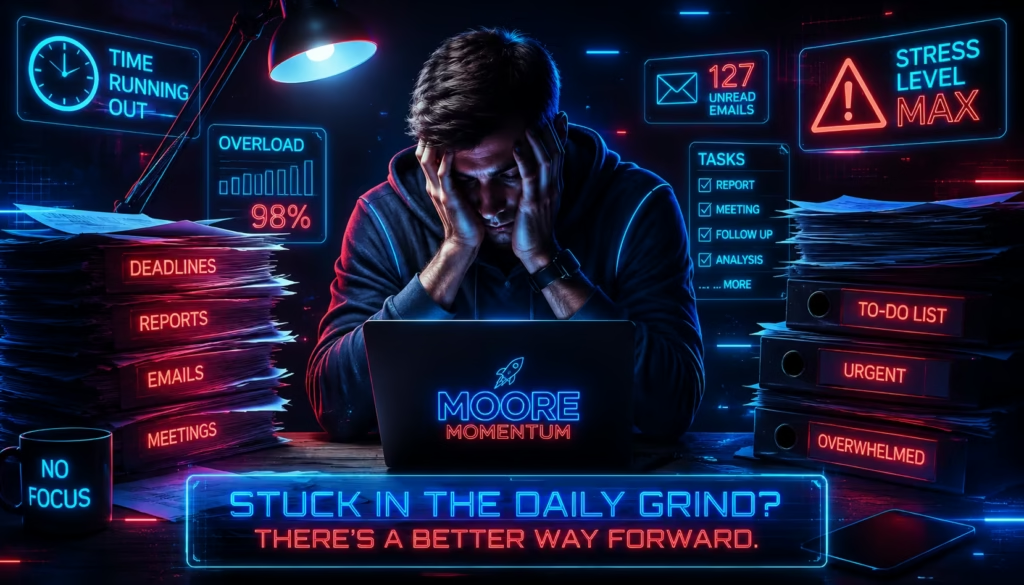
Will Moore built and sold a company for a nine-figure exit. He also spent years running on a tank that was quietly emptying, telling himself exhaustion was the price of ambition. It was not. What he learned the hard way, and spent 30 years turning into a system, is that burnout is never a single dramatic collapse. It is a slow leak, and nobody notices until the tank hits zero.
That is the real problem. Learning how to prevent burnout is not about knowing what burnout is. You already know. It is about spotting the drift while it is still small enough to fix in ten minutes a day instead of six months of medical leave.
AI changes that equation. It is good at exactly what humans are worst at: noticing slow patterns in our own behavior. It does not get tired, rationalize, or call this “just a weird week” for the fifth week running.
Quick answer: To prevent burnout, score your energy across all five core areas of life weekly, identify the single biggest friction point draining you, and replace it with one small personalized habit. Use AI to detect declining patterns early, then strip out friction so recovery habits stick without willpower.
Three AI-powered upgrades you will walk away with:
- An early-warning system that flags burnout drift weeks before you would notice it
- Copy-paste prompts that turn a generic chatbot into a diagnostic tool built around your role
- A friction-removal blueprint so recovery habits survive a brutal work week
Why Burnout Wins: The Warning System Your Brain Never Built
The World Health Organization classifies burn-out in ICD-11 as an occupational phenomenon rather than a medical condition, describing it as a syndrome resulting from chronic workplace stress that has not been successfully managed, marked by energy depletion, cynicism toward your job, and reduced professional efficacy.
Read that middle dimension again. Cynicism does not feel like a symptom. It feels like clarity: the meeting is pointless, the project is doomed, your manager is useless. Your brain reframes a warning light as wisdom, which is why the earliest signs of employee burnout look like a bad attitude. If you want to see exactly where you sit on the slope, the 12 stages of burnout map the progression from mild overdrive to full shutdown.
The cost of missing it is brutal. A Swedish study of patients treated for stress-related exhaustion found one-third still showed symptoms of clinical burnout 18 months later, and the strongest predictor of slow recovery was how long they waited before seeking help. A separate 10-year follow-up found problems persisting for a subset of patients a full decade after rehabilitation.
Waiting is the expensive part. Which is why the entire strategy for how to prevent burnout has to shift from “recover after” to “detect during.”
There is a second blind spot. Burnout gets treated as a work problem, so people reach for work solutions: better time blocking, a firmer no, another app. But energy is not compartmentalized. The Moore Momentum System organizes life into the 5 Core Areas of Life: Mindset, Career & Finances, Relationships, Physical Health, and Emotional & Mental Health. Burnout rarely starts in Career alone. It starts when Physical Health drops from sleep debt, which drags down Mindset, which drains Relationships as you cancel plans, which removes the exact recovery source you needed. By the time work performance dips, four cores have been bleeding for weeks.
That is the Ripple Effect running in reverse, and it is precisely the kind of slow, multi-variable drift AI is built to catch. It is also why finding balance across all five cores beats optimizing any single one.
The 5-Step AI System for How to Prevent Burnout
This is an implementation guide, not a list of tips. Each step includes a prompt you can paste into any capable AI assistant. Run steps 1 through 4 once in a single 30-minute session. Step 5 becomes a four-minute weekly ritual.
Step 1: Run an AI Burnout Audit Across All 5 Core Areas
You cannot fix what you cannot see. Most self-assessments fail because they ask how you feel right now, and right now is noisy. A useful audit asks about trajectory instead.
“Act as a behavioral scientist specializing in occupational burnout. I’m scoring five life areas from 1 to 5 for the past two weeks: Mindset, Career & Finances, Relationships, Physical Health, Emotional & Mental Health. My scores: [scores]. My role: [job, hours, remote or on-site, caregiving]. Ask me 5 follow-up questions to identify which core is the root drain versus which are downstream symptoms, then tell me which one to address first and why.”
That last instruction is the important one. Most people attack the loudest core rather than the leaking one.
Success metric: You finish able to name one core, not five problems. If the AI hands you a generic wellness lecture, add “skip advice I could find in any article.”
Step 2: Let AI Name Your Real Pain Point
This is where the Moore Momentum System’s Habits Hierarchy System works, moving from vague complaint to precise habit through five stages: pain point, related core, core habit, keystone habit personalization, and finally your Golden Habit.
Vague: “I’m exhausted.” Precise: “I never mentally leave work because my laptop stays open on the kitchen table until I fall asleep.” The second one is solvable.
That distinction matters for anyone researching how to prevent burnout at work, because the fix for “too much work” is usually outside your control, while the fix for “no shutdown ritual” sits entirely inside it. Research on daily recovery found what employees do with off-job time meaningfully predicts recovery levels, independent of how demanding the day was.
“Convert my vague complaint into one specific, observable pain point. Walk my routine hour by hour on a typical bad day, then identify the exact moment energy leaks out. Give me 3 candidate pain points ranked by how much they drain and how much control I have over them.”
Success metric: One sentence naming a specific moment in your day, with a time attached.
Step 3: Build One Golden Habit That Protects Your Energy
A Golden Habit is not a goal. It is a small, specific behavior validated against three criteria: you genuinely WANT to do it, you realistically CAN do it, and you KNOW it will be effective against the pain point.
Skip any one and the habit dies in week two. Most burnout advice fails the first test spectacularly. Telling an exhausted nurse to journal 20 minutes at 5am is not a plan, it is a punishment.
“Generate 3 candidate Golden Habits for my pain point. Each must take under 10 minutes, attach to something I already do daily, and be something I’d plausibly enjoy. My strengths, passions, and constraints: [3 of each]. Rate each 1-10 on WANT, CAN do it on my worst week, and EFFECTIVE. Recommend one.”
Notice “on my worst week.” That constraint eliminates most habits that would have failed you. If it does not survive your worst week, it is not a habit, it is a mood. Our guide to healthy habits examples across all five cores shows what small actually looks like.
Step 4: Apply the 3 Momentum Boosting Methods to Kill Friction
You now have one habit. Statistically it will not stick, because knowing what to do has almost nothing to do with doing it. That knowledge-action gap is why understanding how to prevent burnout so rarely translates into preventing it.
The MM System closes the gap with the 3 Momentum Boosting Methods, evolved from the work of James Clear, BJ Fogg, and Charles Duhigg:
- Make it Obvious or Attractive. Engineer your environment so the cue is unmissable. Wendy Wood’s research on the psychology of habit shows how much daily behavior is triggered by stable context rather than conscious intention.
- Make it Easy. Strip every step between you and the action, and add steps in front of the behavior you are replacing.
- Make it Fun or Rewarding. Bundle the habit with something you already enjoy so dopamine arrives during the action, not after.
This is also the antidote to work from home burnout, which is an environmental problem rather than a motivation problem. When your office and bedroom are the same 400 square feet, nothing physically signals your nervous system that the day is over.
“Apply three friction-reduction methods to my Golden Habit. MAKE IT OBVIOUS: 3 one-time environmental changes I can make this weekend, plus any I could automate with a smart device or calendar. MAKE IT EASY: a habit stack formatted ‘After I [existing habit], I will [new habit]’ plus the smallest 2-minute version. MAKE IT FUN: a temptation bundle using something I already look forward to. My setup: [describe].”
One-time actions matter far more than recurring ones. A second charging cable so your laptop lives in a different room than your bed is a five-minute purchase that pays out for years. Compare that to “have better boundaries,” which demands willpower every night forever.
Success metric: Two changes you make once and never think about again.
Step 5: Set Up Your AI Early-Warning Check-In
This separates prevention from recovery, and almost nobody does it.
Four minutes a week. Score your five cores 1 to 5, write two sentences on what drained you and what refilled you, then feed it to your AI alongside your running log. In the MM System this ritual lives in your Captain’s Log inside the Command Center. For a simple offline version, our weekly habit tracker does the same job on paper.
“Here are my weekly core scores and notes for the last [X] weeks: [paste log]. Act as my pattern-detection system. Tell me: (1) which core is trending down over 3+ weeks even if the drop is small, (2) any theme appearing 3+ times in my notes, (3) whether my scores contradict the tone of what I wrote, and (4) one adjustment for this week. Flag early burnout drift and be direct.”
Point 3 catches something humans are terrible at. People routinely score a week a 4 while writing “I cried in the car again.” AI spots that mismatch instantly, and the gap between what you rate and what you write is often the earliest reliable signal available. This is the highest-leverage move in any plan for how to prevent burnout: three consecutive weeks of decline in any core becomes your trigger to act. Not to panic or quit. Just to run steps 2 through 4 again on the new leak.
How to Prevent Burnout at Work: Strategies by Role
Burnout is not evenly distributed. Some roles carry structural load no amount of habit design fully offsets, so the strategy changes with the job.
How to Prevent Employee Burnout and Reduce Employee Burnout on Your Team
For individual contributors, the highest-leverage move is protecting the recovery window rather than optimizing the workday. Detachment after hours predicts next-day energy more reliably than how hard you worked during them.
If you manage people, the question shifts from how to prevent employee burnout in yourself to catching it in others. The signs of employee burnout are behavioral before they are verbal: camera off in meetings where they used to be on, quality slipping on tasks they used to nail, erratic response times, and a drop in voluntary contribution. Cynical humor is a signal, not a personality trait, and it is one of the signs of employee burnout people most often excuse.
Managers who want to reduce employee burnout get more return from deleting three recurring low-value obligations than from adding one wellness perk. The fastest way to reduce employee burnout is usually to kill a meeting, not buy a meditation app, which pairs with the thinking behind work habits that compound instead of drain.
On the individual-contributor side of the same problem, these productivity tips for work that actually stick cover the daily execution layer that keeps a manageable workload from turning into an unmanageable one.
“I manage a team of [X] in [industry]. Here’s what I’ve observed about a team member over 6 weeks: [describe]. Separate the signs of employee burnout from disengagement, a personal issue, or a skills mismatch, since each needs a different response. Then draft 3 non-invasive 1:1 questions to help me reduce employee burnout risk without making them feel surveilled.”
How to Prevent Teacher Burnout
Teaching carries a specific load: emotional labor, unpaid hours, low calendar autonomy. RAND’s 2026 State of the American Teacher survey found teachers were more likely than similar working adults to report poor well-being on every indicator, a pattern that has held every year since 2021.
The practical answer to how to prevent teacher burnout is almost never “work fewer hours,” because that lever is not available in October. It is boundary automation: an email cutoff enforced by scheduled send delay rather than self-discipline, three fallback lesson plans banked for depleted days, and a decompression ritual that starts in the car. Automate the boundary and you stop paying a willpower tax on it daily.
How to Prevent Nurse Burnout
Nursing runs on emotional exhaustion as the leading edge. A global umbrella review estimated emotional exhaustion prevalence among nurses at roughly 33%, and NCSBN research found large shares of U.S. nurses felt emotionally drained or used up multiple times per week.
Standard advice to build a morning routine that actually sticks works beautifully on a fixed schedule and falls apart on a rotating one. The workable approach to how to prevent nurse burnout is anchoring habits to shift events rather than clock times: after handoff, after the drive home, after the first real meal. Those stacks survive schedule chaos because they travel with you. Micro-recovery also beats saved-up recovery, since two 90-second resets mid-shift outperform one heroic day off swallowed by errands.
How to Beat Work From Home Burnout
Remote workers face the opposite problem from frontline staff: too little structure rather than too much. Work from home burnout is driven by boundary collapse, where the commute that once served as a psychological airlock has vanished and work bleeds into every room. Work from home burnout also hides longer than the office version, because no colleagues are watching you fade. Turning screen time into recovery rather than drain is the whole point of building AI-powered digital habits.
The fix for work from home burnout is manufactured transitions. A 10-minute walk that ends where your workday ends. A different light setting after 6pm. A laptop that physically leaves the room at 6:01. Task-switching accelerates work from home burnout too, which is why single-tasking beats multitasking for protecting energy. Anyone learning how to prevent burnout at work from a home office should build the transition first and the productivity system second.
How to Recover From Burnout While Still Working
Prevention assumes you caught it early. Plenty of people searching how to recover from burnout while still working are already past that point, and the good news is the same system works in reverse.
Recovery rests on three moves that do not require quitting. Protect recovery time aggressively rather than cutting hours you may not control. Reclaim autonomy somewhere small, since control over even minor decisions buffers strain. Subtract one recurring obligation instead of stacking a new wellness routine onto an overloaded schedule.
Then run the same five steps with one change: start smaller. Every guide on how to recover from burnout while still working underestimates this part. If your Golden Habit takes ten minutes, cut it to two. How to recover from burnout while still working fails most often because people design a plan for the person they were before burnout. Depleted-you has to execute it, so build for depleted-you. If busyness itself became your coping mechanism, toxic productivity is worth five minutes.
Real-World Example: How Maya Caught Burnout in Week Three
Maya is a 29-year-old remote product manager. She was not in crisis. She was, in her words, “just kind of flat.”
Her Step 1 audit: Mindset 3, Career 4, Relationships 2, Physical Health 2, Emotional & Mental Health 3. Her instinct was to fix Career, because that is where the stress came from. The AI pushed back. Career was the highest number on the board. The actual leak was Physical Health, with Relationships as the downstream casualty.
Step 2 found the moment. Every night at 9:40pm she opened Slack “just to check,” reliably costing 40 minutes of sleep and a first meeting she attended half-conscious.
Her Golden Habit: at 9:30pm, phone goes on a charger in the hallway. Step 4 removed the friction: a $12 alarm clock so her phone no longer had a bedroom job (Make it Easy), the charger moved beside the light switch she already touched nightly (Make it Obvious), and a paperback saved as the reward for the handoff (Make it Fun).
By week three her check-in caught something she had not registered. Her Relationships score climbed from 2 to 4 without her doing anything about relationships, because better sleep meant she stopped cancelling on friends. That is the Ripple Effect running forward, and the AI flagged it before she saw it.
The honest part: her workload did not change and neither did her boss. She stopped compounding a hard job with a self-inflicted sleep deficit, which bought enough margin to handle the hard job.
Frequently Asked Questions
How long does burnout last?
How long does burnout last depends on how early you intervene and whether the underlying conditions change. Mild cases caught early often improve within weeks. In clinical populations recovery is far slower: one study of patients treated for stress-related exhaustion found one-third still had burnout symptoms at 18 months, and how long symptoms went unaddressed predicted recovery. Asking how long does burnout last is really asking how long you waited.
How do you recover from burnout while still working?
How to recover from burnout while still working means protecting recovery time, reclaiming a small amount of autonomy, and subtracting one recurring obligation rather than adding a routine on top. Rest combined with structural change outlasts rest alone. It has limits. If you are experiencing physical symptoms, persistent hopelessness, or an inability to function, how to recover from burnout while still working stops being the right question and a licensed professional becomes the right answer.
What are the early signs of employee burnout?
The signs of employee burnout cluster into three groups. Exhaustion looks like fatigue a weekend no longer touches. Cynicism looks like detachment, irritability, and dark humor about work that used to matter. Reduced efficacy looks like familiar tasks taking longer and confidence dropping on work done a hundred times. Watch for changes sustained over four or more weeks. If the exhaustion arrives with boredom rather than overload, you may be looking at boreout, burnout’s under-stimulated opposite, which needs the reverse fix.
How can managers reduce employee burnout without a big budget?
The most effective way to reduce employee burnout costs nothing: audit recurring obligations and delete the lowest-value third. Then make after-hours detachment a visible norm, since teams copy what leaders do rather than what they say. Asking how to prevent employee burnout usually surfaces workload and clarity problems long before it surfaces wellness-program gaps.
How do you prevent burnout at work if you cannot reduce your workload?
Learning how to prevent burnout without control over workload means focusing on the three levers you own: recovery quality, environmental friction, and boundary automation. Automated boundaries beat willpower boundaries every time, because they do not require a good decision from a depleted brain. The same logic applies to how to prevent teacher burnout and how to prevent nurse burnout, where staffing and scheduling sit above the individual. If the workload is genuinely unsustainable, habits are damage control, and the honest next step is a conversation about scope.
Can AI actually help prevent burnout, or is it just a chatbot?
AI is not a therapist and should not be treated as one. What it does exceptionally well is detect patterns across time, translate vague feelings into specific behaviors, and generate personalized options instead of generic advice. Used as an early-warning layer on your weekly reflection, it catches drift you would rationalize away. Used as a replacement for human support or clinical care, it fails. For a non-technical starting point, our 7 proven ways to prevent burnout before it starts covers the basics.
🚀 YOU’VE SEEN HOW AI SPOTS THE LEAK. NOW LET IT MAP YOUR WHOLE ENGINE.
Everything you just read comes straight out of the AI-powered Habits Coach AI System, where the same pattern detection that catches burnout drift also personalizes your habits, predicts your obstacles, and keeps momentum alive across all 5 Core Areas of Life. Instead of guessing which core is bleeding, let our AI show you which one is silently draining your progress with a personalized Momentum Score built from your values, habits, and friction points. It takes under 60 seconds and unlocks a custom AI Momentum Map, so your next Golden Habit is the one most likely to work for you. Knowing how to prevent burnout is not a willpower problem. It is a personalization problem, and that is exactly what we solve.
Start your personalized AI assessment HERE!
🚀🚀🚀 Don’t forget to check out our RESOURCE ARCADE 👾🎮 for FREE templates and tools to gamify your habits.