Quick answer: To rebuild your life, take an honest inventory of five core areas (mindset, career and finances, relationships, physical health, emotional wellbeing), find the one problem that drags the others down, and fix it with a single small “golden habit.” Then make that habit obvious, easy, and rewarding, and review your progress every week. Most new habits take about two months to stick, so think in seasons, not days.
Sarah stared at the kitchen table: divorce papers, a layoff notice from the job she’d held for eight years, and a bank balance that barely covered next month’s rent. At 34, she felt like she was starting from zero. Every self-help book told her to “think positive” and “set goals.” None of them told her what to do first.
What finally helped wasn’t a burst of motivation. It was a plan built around her situation: one small habit, one weekly check-in, and an AI assistant she used to think through her options. Six months later, she was working in a new field, sleeping through the night again, and had started seeing friends she’d been avoiding.
Disclaimer: Sarah is an illustrative composite based on common rebuilding experiences, not a single real person. Names and details have been changed.
If you’re searching for how to rebuild your life, you probably don’t lack determination. You lack a starting point that fits your circumstances. This guide gives you one.
What you’ll get from this guide:
- A 6-step system for rebuilding your life that works whether you’re starting over after a divorce, a job loss, or a personal crisis
- How to pick one high-leverage “golden habit” instead of trying to change everything at once
- Situation-specific advice for rebuilding after trauma, divorce, loss, or losing everything
- A copy-and-paste AI prompt that turns ChatGPT, Claude, or Gemini into a personal planning partner
What Does It Mean to Rebuild Your Life?
Rebuilding your life means deliberately reconstructing your routines, relationships, finances, and sense of identity after a major disruption has knocked them down. It differs from simply “moving on.” Moving on is about leaving something behind; rebuilding is about deciding what you’ll construct in its place.
Common triggers include divorce or a breakup, job loss or financial collapse, the death of a spouse or loved one, recovery from addiction, a health crisis, or a slow realization that the life you’ve built no longer fits. If your situation is less about a single event and more about drifting off course, our guide on how to get your life back on track may be a closer match.
Why Most Attempts at Rebuilding Your Life Stall
Most people try to rebuild with willpower and a long to-do list. Both run out fast. Behavior scientist BJ Fogg’s Behavior Model explains why: a behavior happens only when motivation, ability, and a prompt show up at the same moment. After a crisis, motivation swings wildly, so the plan that depends on it collapses on the first bad day.
Three patterns show up again and again:
- Changing everything at once. A new diet, a new job hunt, a new gym routine, and a new budget, all in week one. Overload leads to quitting.
- Treating symptoms, not causes. Overspending gets a budget, but the stress driving the overspending gets ignored.
- Expecting results in 21 days. A 2024 systematic review found habit formation typically takes around two to five months, and a well-known UCL study put the median at 66 days. People quit right before the habit would have become automatic.
The good news: setbacks don’t have to define you. Psychologists Richard Tedeschi and Lawrence Calhoun documented post-traumatic growth, the finding that many people report greater personal strength, deeper relationships, and new possibilities after a major struggle. Growth isn’t automatic, but it is common when people rebuild with intention.
How to Rebuild Your Life: The 6-Step System
Here is how to rebuild your life one manageable step at a time. Do them in order; each step feeds the next.
Step 1: Take an Honest Inventory of Where You Are
You can’t plan a route without knowing your starting point. Rate each of the five core areas of your life from 1 to 10, then write one concrete sentence about each:
| Core area | Example of a vague note | Example of a useful note |
|---|---|---|
| Mindset | “I’m negative.” | “I tell myself I’ll never recover financially.” |
| Career & finances | “Money is bad.” | “I have 6 weeks of savings and no income.” |
| Relationships | “I’m lonely.” | “I haven’t called my sister in three months.” |
| Physical health | “I’m out of shape.” | “I sleep about 5 hours and skip breakfast.” |
| Emotional wellbeing | “I’m stressed.” | “I feel panicky every morning before 9 a.m.” |
Specific notes reveal patterns. Vague notes just confirm that things feel bad.
Step 2: Map How Your 5 Core Areas Connect
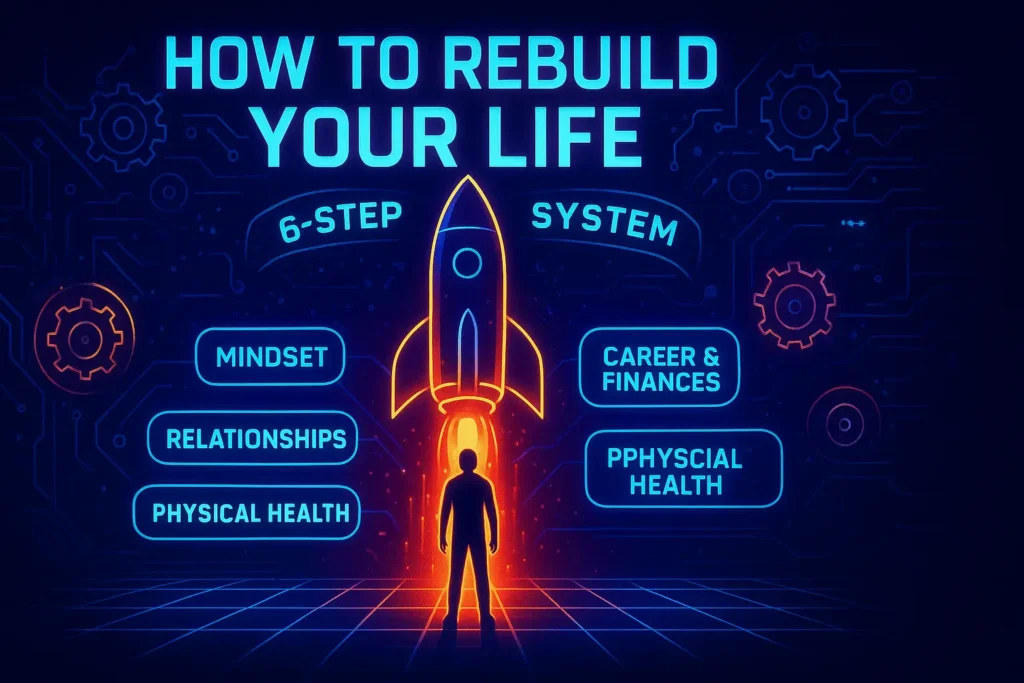
Your life works like a rocket with five thrusters: mindset, career and finances, relationships, physical health, and emotional wellbeing. When one fails, the others strain to compensate.
Poor sleep (physical) makes you irritable (emotional), which strains your relationships, which hurts your focus at work. The reverse is also true. Fix the right area and the improvement spreads. That’s why rebuilding yourself works better as a system than as a set of separate goals.
Step 3: Find the Root Cause, Not Just the Symptom
Use the “5 Whys” technique on your lowest-scoring area. For example:
- Why am I behind on bills? I overspend.
- Why do I overspend? Shopping makes me feel better.
- Why do I need to feel better? Evenings feel empty since the divorce.
- Why do evenings feel empty? I stopped seeing friends.
- Why did I stop? I’m embarrassed about what happened.
The real lever here isn’t a budget app. It’s reconnection. Prioritize the pain point that touches the most core areas; that’s where your effort pays back fastest.
Step 4: Choose One Golden Habit
A golden habit is a single, small behavior that targets your biggest pain point and creates momentum across several areas at once. It’s closely related to what Charles Duhigg calls keystone habits.
A good golden habit is:
- Small enough to do on your worst day (10–15 minutes, not an hour)
- Linked to your root cause from Step 3
- Matched to your natural rhythm (morning person or night owl)
Examples: a 15-minute morning routine of breathing, writing three priorities, and stretching; a nightly phone-free walk; or one text to a friend every day at lunch.
Step 5: Make the Habit Obvious, Easy, and Rewarding
Instead of relying on willpower, design your environment so the habit happens almost on autopilot.
- Make it obvious: Lay out your journal or walking shoes the night before. Use an “if-then” plan: “If I pour my morning coffee, then I write my three priorities.” Research on implementation intentions shows if-then plans meaningfully improve follow-through.
- Make it easy: Shrink the habit until it’s hard to skip. Remove friction for good habits and add friction to bad ones (log out of shopping apps, move the TV remote to another room).
- Make it rewarding: Track a streak, check a box, or pair the habit with something you enjoy. Immediate rewards keep you going while long-term results take shape.
Step 6: Track Leading Indicators and Adjust Weekly
Rebuilding your life isn’t a straight line, so build in review points.
- Track behaviors, not just outcomes. Count “days I did my morning routine,” not just “pounds lost” or “dollars saved.” You control behaviors; outcomes lag behind.
- Run a 10-minute weekly review. What worked? What didn’t? If you keep missing the habit, shrink it or move it; don’t just “try harder.”
- Do a monthly five-area check. Re-score the five core areas from Step 1. Once your golden habit is automatic, add a second one in the next-weakest area.
Expect missed days. Research on habit formation shows that missing an occasional day doesn’t meaningfully derail the process. What matters is getting back on track the next day. For a deeper look at timelines, see how many days it takes to make a habit.
How to Rebuild Your Life After Specific Setbacks
The six steps apply to everyone, but your starting point changes with your situation.
After Divorce or a Breakup
Rebuilding life after divorce usually starts with routines and relationships, because both were shared. Re-establish a daily structure you own (meals, sleep, exercise), rebuild one or two close friendships, and get clear on your finances in writing. Strong social ties are one of the most powerful predictors of health and longevity, according to a large meta-analysis. If you’re still processing the loss, our guide on how to get over someone you love walks through the emotional side.
After Losing Everything (Job, Money, or Business)
When you need to rebuild your life after losing everything, stabilize first and optimize later. Cover the basics (housing, food, income), then pick a golden habit in your career core, such as one job application or one networking message per day. Small, daily proof that you’re moving forward rebuilds confidence faster than big plans.
After Trauma
If you’re working out how to rebuild your life after trauma, safety and regulation come before goals. Gentle routines (consistent sleep, short walks, breathing exercises) help calm the nervous system. The American Psychological Association’s guide to building resilience recommends prioritizing relationships and self-care. Trauma often benefits from professional support, such as a trauma-informed therapist.
After the Death of a Spouse or Loved One
Grief doesn’t follow a schedule, and rebuilding after the death of a spouse isn’t about “getting over” the loss. Start with the smallest anchors: eating regular meals, getting outside daily, and accepting help when it’s offered. Grief support groups and counselors can help you build a new life that still honors the person you lost.
After Addiction or Rock Bottom
Rebuilding life after addiction depends on structure and support. Recovery programs, peer groups, and medical guidance should come first; habits like consistent sleep, exercise, and daily check-ins with a sponsor or friend then support long-term recovery. If you’re at rock bottom and feel like quitting, read what to do when you feel like giving up.
Important: This article is for general education and isn’t a substitute for professional mental health or medical care. If you’re in crisis or thinking about harming yourself, contact your local emergency number. In the U.S., you can call or text the 988 Suicide & Crisis Lifeline.
Rebuilding Yourself vs. Starting Over: What’s the Difference?
| Rebuilding yourself | Starting over | |
|---|---|---|
| Starting point | Keeps what still works | Leaves the old situation behind |
| Typical trigger | Crisis, loss, burnout | Relocation, career change, new chapter |
| Focus | Repairing core areas and identity | Building something new from scratch |
| Best first move | Inventory and one golden habit | Define the new direction, then plan |
Many people need both. If a clean break fits your situation better, read our guide on how to start over in life.
AI Prompt to Help You Rebuild Your Life
Copy and paste this prompt into ChatGPT, Claude, Gemini, or any AI assistant to turn the six steps into a personal plan:
“I want to rebuild my life using a step-by-step, science-based approach. Act as a supportive life strategist and guide me one step at a time. Wait for my answer before moving to the next step.
Step 1 – Inventory: Ask me to rate and describe five areas of my life: mindset, career and finances, relationships, physical health, and emotional wellbeing. Ask follow-up questions until my answers are specific.
Step 2 – Connections: Show me how problems in one area may be affecting the others.
Step 3 – Root cause: Use the ‘5 Whys’ with me on my lowest-scoring area.
Step 4 – Golden habit: Recommend ONE habit under 15 minutes that targets my root cause and fits my schedule.
Step 5 – Design: Help me write an if-then plan for the habit, remove obstacles, and choose an immediate reward.
Step 6 – Tracking: Give me 2–3 behaviors to track and a simple weekly review template.
Keep your advice specific to my situation, not generic. If anything I share suggests I need professional or crisis support, tell me clearly.”
Tips for better results: Be honest and specific, describe real examples rather than general feelings, and return to the same chat each week so the AI can adjust your plan as things change.
Real-World Example: One Habit, Five Areas
Marcus was 42 when he lost his business and went through a bitter divorce in the same year. His anxiety got so bad that some days he couldn’t leave his apartment.
His inventory showed three problems: financial panic, isolation, and a belief that his failures were permanent. The root cause was a morning anxiety spiral that set the tone for every day. His golden habit became a 15-minute routine: five minutes of breathing, five minutes writing three priorities, and five minutes of stretching. He set out his journal and mat each night, and rewarded himself with his favorite coffee afterward. On bad days, he did a one-minute backup version so the streak stayed alive.
Six months later, he’d launched a small consulting business, reconnected with old friends, and started dating again. One habit didn’t fix everything, but it gave him the stability to tackle everything else.
Disclaimer: Marcus is an illustrative composite example, not a specific individual. Results vary, and anyone dealing with severe anxiety should seek support from a licensed professional.
Conclusion: Your Rebuild Starts With One Habit
Learning how to rebuild your life isn’t about overhauling everything overnight. The people who come back strongest after a divorce, a layoff, a loss, or a rock-bottom year rarely do it with one dramatic leap. They do it with a clear picture of where they stand, one well-chosen habit, and the patience to let small wins stack up.
Here’s the whole system in one place:
- Take an honest inventory of your five core areas: mindset, career and finances, relationships, physical health, and emotional wellbeing.
- Map the connections so you can see how a problem in one area drags down the others.
- Find the root cause with the “5 Whys” instead of treating surface symptoms.
- Choose one golden habit small enough to do on your hardest day.
- Make it obvious, easy, and rewarding so it runs on design, not willpower.
- Track and adjust weekly, then add a second habit once the first feels automatic.
If you’re wondering where to begin tonight, keep it simple. Spend ten minutes scoring your five core areas, circle the lowest one, and write a single if-then plan for tomorrow morning. That’s it. You don’t need the full plan before you start; the plan gets clearer as you move.
Be patient with the timeline. Most habits take around two months to feel automatic, and real change across several life areas usually unfolds over six months to a year. You’ll miss days. That’s normal and doesn’t erase your progress. What matters is getting back to your habit the next day rather than waiting for a “fresh start” on Monday.
And remember that rebuilding yourself doesn’t mean doing it alone. Lean on friends, family, support groups, or a licensed professional, especially if you’re recovering from trauma, grief, or addiction. An AI assistant can help you plan and stay accountable, but people help you heal.
Your old life may have fallen apart, but that also means you get to decide what goes into the new one. Start with one habit, protect it for a few weeks, and watch momentum spread from one core area to the next. Rebuilding your life is a process, and today is a perfectly good day to start it.
🚀 What if rebuilding your life felt like pressing start on a new game?
The HabitsCoach AI System makes rebuilding simple, science-backed, and AI-personalized. Instead of guessing what to fix first, you earn streaks, points, and visible progress across all 5 Core Areas of Life, with a quick daily check-in that adapts as your life changes.
👉 Start with a 60-second win. Take the free Core Values Quiz to get your personalized Momentum Score and discover which Golden Habit will kick-start your rebuild.
PRESS START ON YOUR NEW LIFE NOW!
🚀🚀🚀 Don’t forget to check out our Resource Arcade 👾🎮 for FREE templates and tools to gamify your habits.
FAQs About Rebuilding Life
How do I rebuild my life after losing everything?
Stabilize the basics first: housing, food, and a source of income. Then take a quick inventory of your five core areas, choose one small daily habit that addresses your biggest pain point (such as one job application a day), and track it weekly. Small wins rebuild confidence faster than big plans.
How long does it take to rebuild your life?
There’s no fixed timeline, but most new habits take around two months to become automatic, and meaningful change across several life areas usually unfolds over six months to a year. Focus on consistency rather than speed.
Where do I start when rebuilding yourself?
Start with an honest assessment of your mindset, career and finances, relationships, physical health, and emotional wellbeing. Then pick the one area whose improvement would help the others most, and build a single golden habit there.
How do I rebuild my life after trauma?
Begin with safety and nervous-system regulation: consistent sleep, gentle movement, and supportive relationships. Add goals gradually. Working with a trauma-informed therapist is strongly recommended, since trauma can affect memory, mood, and motivation in ways that are hard to manage alone.
How do I rebuild my life after divorce?
Create a daily routine that belongs to you, reconnect with friends and family, get clear on your finances in writing, and choose one habit that supports your emotional wellbeing. Give yourself time to grieve the relationship while you build the next chapter.
What to do if you no longer enjoy life?
Start small: get outside daily, move your body, and reconnect with one person you trust. If the feeling lasts more than two weeks or comes with hopelessness, talk to a doctor or mental health professional, since it may be a sign of depression. If you’re in crisis, contact your local emergency number or the 988 Lifeline in the U.S.
Can AI help me rebuild my life?
Yes, as a planning partner. AI tools can ask structured questions, spot patterns across life areas, and suggest habits tailored to your schedule. They don’t replace therapists, doctors, or real-world support, but they make it easier to turn good intentions into a concrete daily plan.