Quick answer: To get over someone you love, grieve on purpose instead of suppressing it, stop checking on them online, remove the cues that keep pulling you back, honestly reappraise the relationship, and replace rumination with small daily habits that rebuild your identity. For many people the worst of it eases within about three months, though long relationships often take longer.
When someone you love leaves your life, it can feel physical. That’s not in your head. In a 2011 brain-imaging study led by University of Michigan psychologist Ethan Kross, looking at a photo of an ex who had recently rejected them activated the same sensory regions of the brain that respond to physical pain.
So if you’ve been replaying the last conversation, refreshing their profile at midnight, or drafting messages you never send, you’re not weak. Your brain is reacting to a real loss. The good news is that researchers have mapped out how to get over someone you love, step by step.
Here’s what this guide covers:
- Why letting go of someone you love feels so hard (the brain science, in plain English)
- How long it really takes to get over someone
- Seven practical steps to heal and rebuild
- Which coping strategies work, and which quietly backfire
- How to help someone get over a breakup if you’re supporting a friend
📊 Key Stats at a Glance
| Finding | Source |
|---|---|
| Rejection in love activates the brain’s reward and craving circuits, including regions linked to cocaine addiction | Fisher et al., Journal of Neurophysiology, 2010 |
| 71% of people reported meaningful personal growth after a breakup, with most feeling better around the 11-week mark | Lewandowski & Bizzoco, Journal of Positive Psychology, 2007 |
| Checking an ex’s Facebook was linked to more distress, more longing, and less personal growth | Marshall, Cyberpsychology, Behavior, and Social Networking, 2012 |
| About 43% of daily actions are habits triggered by context, not conscious choices | Wendy Wood, USC |
| Weak social connection carries a mortality risk comparable to smoking up to 15 cigarettes a day | Holt-Lunstad et al., PLOS Medicine, 2010 |
Why Is Letting Go of Someone You Love So Hard?
Letting go of someone you love is hard because romantic love runs on the brain’s reward system. When the relationship ends, that system keeps firing, and it keeps pointing at the person who’s gone.
Anthropologist Helen Fisher and her team scanned the brains of people who had just been rejected but were still intensely in love. Their study in the Journal of Neurophysiology found activity in the ventral tegmental area and the nucleus accumbens, regions tied to motivation, reward, and craving. Some of those same areas light up in cocaine addiction. That helps explain the obsessive checking, the urge to text, and the way a single song can undo a good week.
There’s a second layer too. When a person is woven into your mornings, weekends, and plans, their absence leaves gaps everywhere. Your routines, your social life, even your sense of who you are all have a hole where they used to be.
Put those together and you get the core problem: your logical brain knows it’s over, but your reward system and your daily habits haven’t caught up yet. The struggle isn’t a character flaw. It’s wiring. And wiring can be rewired, which is exactly what learning how to let go of someone you love is about.
How Long Does It Take to Get Over Someone?
There’s no fixed timeline, but research gives a useful benchmark. In a study of 155 young adults, psychologists Gary Lewandowski and Nicole Bizzoco found that 71% reported high levels of personal growth after a breakup, and later coverage of the work pointed to roughly 11 weeks as the point where most people started to feel better.
Keep three caveats in mind:
- The study looked at young adults and mostly shorter relationships. Marriages and long-term partnerships usually take longer because more of your life is intertwined.
- Rumination slows recovery. In a Stanford study of 253 grieving adults, psychologist Susan Nolen-Hoeksema found that people who dwelled passively on their pain stayed depressed longer than those who didn’t.
- Healing isn’t linear. A bad day in week eight doesn’t mean you’re back at zero. It means a cue fired.
So instead of asking “how long does it take to get over someone?”, a better question is “what am I doing this week that makes healing faster?” That’s what the seven steps below are for.
How to Get Over Someone You Love: 7 Science-Backed Steps
Step 1: Give Yourself Permission to Grieve, on Purpose
If you want to get over someone fast, know this: the quickest way through heartbreak isn’t around it.
Psychologist James Pennebaker’s research on expressive writing found that people who wrote about painful emotional experiences saw real improvements in mental and physical health compared with people who wrote about neutral topics. Pushing feelings down tends to keep the stress response switched on.
Try a structured “grief window”: 15 to 20 minutes a day where you write freely about what you miss, what hurt, and what you’re afraid of. Then close the notebook and go back to your day. Processing has an end point. Wallowing doesn’t.
And don’t force a brave face for everyone around you. Constantly acting fine is exhausting and isolating. If that sounds familiar, read about how to stop pretending to be happy.
Step 2: Cut the Digital Cord
Every time you check their profile, you give your brain a small hit of that person. It’s enough to restart the craving, never enough to satisfy it.
Psychologist Tara Marshall’s study of 464 Facebook users found that people who kept tabs on an ex’s page reported more distress, more negative feelings, more longing, and less personal growth than people who didn’t. Interestingly, simply staying Facebook friends wasn’t the problem. The surveillance was.
That means the goal is to stop watching, not to make a dramatic gesture. Mute their stories, archive old chats, turn off notifications, and delete the shortcut to their profile. If you can’t trust yourself yet, unfollow or block for now. Your phone is part of your healing environment, and you get to design it.
Read More: AI-Powered Healthy Digital Habits for Growth
Step 3: Redesign Your Physical Environment
Your surroundings quietly program your emotions all day.
Psychologist Wendy Wood’s research shows that about 43% of our daily actions are habits, repeated in the same context without much conscious thought. If your space is full of their hoodie, the mug they gave you, and the couch where you always watched shows together, your nervous system will keep circling back to them. Not because you lack willpower, but because cues trigger responses.
Rearrange your space so it feels new. Box up anything that pulls you backward (you don’t have to throw it out). Then add forward-facing cues: running shoes by the door, a book you’ve been meaning to read, a project you’re excited about.
Step 4: Reappraise the Relationship Honestly
If you’re asking how to stop loving someone, this is the step with the most direct evidence behind it.
Psychologists Sandra Langeslag and Michelle Sanchez tested three strategies on people still upset about a breakup. Thinking about the ex’s negative qualities reduced feelings of love for them. Distraction didn’t reduce love, but it did improve mood. Simply accepting the feelings changed neither.
This isn’t about building hatred. It’s about correcting the highlight reel your brain is playing. Write a short, honest list:
- What didn’t work in the relationship?
- What did you tolerate that you wouldn’t want again?
- What did you give up to make it work?
Read the list whenever nostalgia hits. Pair it with healthy distraction (a walk, a call, a workout) so you feel better while the love feelings fade. That’s how to stop loving someone in practice: turn down the intensity of the love while you turn up your mood.
Step 5: Replace Rumination With Intentional Momentum
Rumination is mentally replaying what went wrong, again and again. As Nolen-Hoeksema’s research showed, it’s one of the strongest predictors of depression lasting longer after a loss. The antidote isn’t forced positivity. It’s small, deliberate action.
Checking their profile, rereading old texts, and replaying arguments are habit loops: a cue, a behavior, a brief reward. You break them the same way you break any habit, by swapping the behavior while keeping the cue. Phone in hand at 11 p.m.? Open your journal app instead.
Read More: How to Break a Bad Habit Using Science and Technology
💡 AI Prompt To Copy/Paste:
Use this with ChatGPT, Claude, Gemini, or any AI tool to build a personal momentum plan that turns healing energy into forward motion:
“I’m going through the aftermath of a breakup and want to use this time to rebuild momentum in the areas of my life that matter most. Please act as a science-based habit coach. Guide me step by step and wait for my answer before moving on.
Step 1: Energy Audit. Ask me which area of my life feels most depleted right now (Mindset, Career, Relationships, Physical Health, or Emotional Well-Being) and which activities used to energize me that I’ve drifted away from.
Step 2: Habit Design. Based on my answers, suggest three small daily habits: one for physical energy, one for mindset and identity, and one for social reconnection.
Step 3: Friction Removal. For each habit, ask me one question about my schedule or environment so we can make starting it as easy as possible.
Step 4: 7-Day Starter Plan. Build me a simple, low-pressure 7-day plan that creates momentum without adding overwhelm.”
Example Conversation:
AI: “Which area of your life feels most depleted right now?”
User: “My physical energy is gone. I stopped exercising months ago and I’m barely sleeping.”
AI: “What activities used to energize you that you’ve drifted away from?”
User: “Running. I used to go three mornings a week and it changed my mood for the whole day.”
AI: “Here are your three habits: (1) A 10-minute morning walk. Not a run yet, just a consistent movement trigger. (2) A 5-minute evening journal entry answering, ‘What did I do today that was just for me?’ (3) One meaningful reconnection per week: a text, call, or coffee with someone you’ve been meaning to reach. Now, for the morning walk: what time does your day usually start, and is there a route nearby that doesn’t require driving?”
Step 6: Rebuild Your Identity and Your Circle
Here’s what nobody tells you about long relationships: you slowly reshape yourself around another person. Your tastes, routines, and friendships shift. So when they leave, you don’t just miss them. You miss the version of yourself that existed inside that relationship.
The way forward is active reconstruction, not waiting. Ask yourself:
- What did I stop doing during this relationship?
- Which passions faded?
- Which friendships drifted?
Start reinvesting in those, one small action at a time. If you’re not sure who you are right now, start with this guide on how to find yourself when you are lost.
Your circle matters just as much. A meta-analysis of 148 studies by Julianne Holt-Lunstad and colleagues found that people with stronger social relationships had a 50% greater likelihood of survival, an effect comparable to well-known risks like smoking. You don’t need a crowd. You need a few people who know you. Reply to the group chat, say yes to the invitation, and call the friend who drifted.
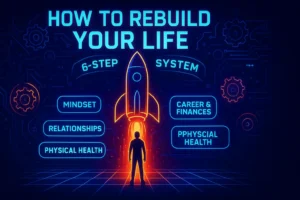
Read More: How to Rebuild Your Life
Step 7: Make the Clean Decision to Walk Away
Knowing how to walk away from someone you love while hope is still on the table is where most people get stuck. But staying tethered by checking their profile, rehearsing what-ifs, and leaving the door “a little open” isn’t loyalty. It’s avoidance.
Write down what holding on has cost you: sleep, focus, opportunities, peace. Not to fuel resentment, but to see clearly. Then make the decision once, on paper, and redirect that energy toward something you’re building.
Letting go of someone you love doesn’t mean erasing them. It means their memory carries less and less charge. That happens when your present becomes more compelling than your past.
Read More: How to Start Over in Life
Which Breakup Coping Strategies Work and Which Backfire?
| Strategy | What the research suggests | Verdict |
|---|---|---|
| Expressive writing in a set time window | Linked to better mental and physical health outcomes (Pennebaker) | ✅ Use daily |
| Honest negative reappraisal of the ex | Reduced feelings of love for the ex (Langeslag & Sanchez) | ✅ Use when nostalgia hits |
| Healthy distraction (exercise, friends, projects) | Improved mood, though it didn’t reduce love on its own | ✅ Pair with reappraisal |
| Leaning on close relationships | Strongly tied to long-term health (Holt-Lunstad) | ✅ Prioritize |
| Checking their social media | Linked to more distress and longing (Marshall) | ❌ Stop |
| Passive rumination | Linked to longer-lasting depression after loss (Nolen-Hoeksema) | ❌ Replace with action |
| Suppressing feelings and “acting fine” | Keeps the stress response running | ❌ Avoid |
How to Get Over Someone You Still Love in Tricky Situations
When You See Them Every Day
Figuring out how to get over someone you see every day takes a different plan. If they’re a coworker, classmate, or part of your friend group, full no-contact isn’t an option. Keep interactions short, polite, and about logistics. Change small parts of your routine, like your route, your lunch spot, or where you sit, so shared spaces start building new associations. Save emotional processing for your grief window, not the break room. You won’t learn how to forget someone you love by avoiding the building. You learn it by making shared spaces feel ordinary again.
When the Relationship Was Unhealthy
It’s common to miss someone even when the relationship hurt you, and that’s often when it’s hardest to get over someone you still love. Unpredictable cycles of closeness and distance can create a stronger bond than steady kindness does, because the brain keeps chasing the next “good” moment. Recognizing that pattern is the first step. For a deeper guide, read how to heal from a toxic relationship.
How to Help Someone Get Over a Breakup
If you’re trying to figure out how to help someone get over a breakup, consistent presence matters more than perfect words.
- Send short, no-pressure check-ins (“Thinking of you. No need to reply.”)
- Offer low-key plans like a walk, a meal, or a movie, without expecting them to be cheerful
- Listen more than you advise, and don’t rush their timeline
- Keep showing up after week two, when most people disappear
When to Get Extra Support
Disclaimer: This article is for educational purposes and isn’t a substitute for professional advice. Heartbreak is painful, but it usually eases with time. If low mood lasts for weeks, disrupts your sleep, appetite, or work, or starts to feel unmanageable, please talk to a licensed therapist or your doctor. Getting help early can shorten the hardest part.
Conclusion: How to Get Over Someone You Love
How to get over someone you love doesn’t come with a shortcut or a fixed deadline. But it does come with a direction.
Grieve on purpose. Cut the digital cord. Redesign your space. Reappraise honestly. Replace rumination with small, steady habits. Rebuild your identity and your circle. And when you’re ready, make the clean decision to walk away from someone you love, and mean it.
The neural pathways that wired themselves to another person can be rewired toward a life you’re excited about. One habit at a time, you’re not just getting through something hard. You’re leveling up into who you were always meant to become.
🚀 What If Getting Over Someone You Love Felt Like Pressing Start on a Brand-New Game?
Heartbreak drains your energy, but healing can build it back with interest. The Moore Momentum System is simple, science-backed, and AI-personalized. It turns your growth into a game, with streaks, points, and visible progress across all 5 Core Areas of Life: Mindset, Relationships, Career & Finances, Physical Health, and Emotional & Mental Health. A quick daily check-in adapts to where you are, so on the hard days you still win small, and on the good days you level up.
👉 Start with a 60-second win. Take the free Core Values Quiz to get your personalized Momentum Score and discover which Golden Habit will help you heal and rebuild fastest right now.
PRESS START ON YOUR HEALING NOW!
🚀🚀🚀 Don’t forget to check out our Resource Arcade 👾🎮 for FREE templates and tools to gamify your habits.
FAQs on How to Get Over Someone You Love
How long does it take to get over someone?
For many people, the worst pain eases within about three months. Research by Lewandowski and Bizzoco found that most participants reported personal growth after a breakup, with around 11 weeks often cited as the turning point. Long-term relationships and marriages usually take longer. Rumination and constant contact slow recovery, while journaling, new habits, and social support speed it up.
How do you stop loving someone?
You can’t switch love off, but you can turn down its intensity. Studies on “love regulation” show that deliberately reminding yourself of an ex’s negative qualities lowers feelings of love, while healthy distraction lifts your mood. Combine both, cut off online surveillance, and remove reminders from your space. Over time, the emotional charge fades.
How do you forget someone you love?
You probably won’t forget them completely, and that’s okay. The realistic goal is for their memory to feel neutral instead of painful. Stop checking their social media, change the routines and spaces you shared, and build new associations with new people and activities. As your present gets fuller, the past takes up less room.
How do you get over someone fast?
There’s no instant fix, but you can avoid the things that make healing slower. Go no-contact if possible, stop scrolling their profiles, schedule a short daily window to process your feelings, and fill your calendar with movement, friends, and one meaningful goal. These steps shorten the craving loop instead of feeding it.
How do you walk away from someone you love when you still have feelings?
Make the decision before the feelings fade, because they lag behind. Write down what staying has cost you, mute or remove the digital cues that reignite the connection, and plan a replacement action for every urge to reach out, like a walk, a journal entry, or a call to a friend. Relief follows consistency.
Is it normal to still love someone after an unhealthy relationship?
Yes. It’s very common. The brain bonds to the person, not the pattern, and unpredictable cycles of affection and distance can make that bond stronger. Still loving them doesn’t mean you should go back. Give yourself patience, lean on people who support you, and consider speaking with a therapist if the pull feels overwhelming.