Quick answer: Winning at life means making steady progress across the five core areas that shape your days — mindset, career and finances, relationships, physical health, and emotional well-being — measured against your definition of success, not someone else’s. You win by setting clear goals, turning them into small daily habits, investing in people, and building systems that keep you moving when motivation runs out.
Most people don’t lose at life because they lack talent. They lose because they play the game of life with borrowed rules. They chase a version of success that looks good on social media, pour everything into one area, and wonder why the rest of their life falls apart.
This guide shows you how to win at life the practical way. No hype, no “grind until you break” advice. Just research-backed strategies you can start using today to succeed in life without sacrificing your health or relationships.
Key Takeaways
- Winning at life is personal. It starts with defining what success means to you across all five core areas.
- Written goals beat good intentions. People who write down goals and track them achieve significantly more than people who only think about them.
- Relationships are the strongest predictor of a good life. Harvard’s 85+ year study found close relationships matter more than money or fame.
- Habits do the heavy lifting. Small, consistent actions compound into big results over time.
- Giving makes you a winner too. Helping others is linked to better health and a longer life.
What Does It Mean to Win at Life?
Winning at life doesn’t mean beating other people. It means becoming the best version of yourself and building a life that matches your values.
That sounds simple, but most of us never stop to ask what “winning” looks like for us. We inherit a scoreboard from parents, peers, or the internet. Then we keep score with the wrong numbers.
If you’ve searched for the winning at life meaning, here it is in one line: winning at life means living by your own values while growing in every area that matters to you.
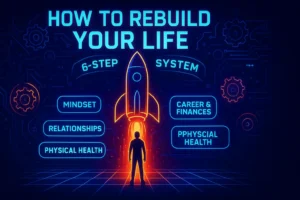
A better approach is to define success on your own terms across five dimensions:
- Mindset — how you think, learn, and handle setbacks
- Career and finances — meaningful work and money that gives you options
- Relationships — deep connections with family, friends, and community
- Physical health — energy, strength, and vitality
- Emotional well-being — calm, resilience, and a sense of purpose
Here’s how winning at life compares with simply looking successful:
| Looking Successful | Winning at Life |
|---|---|
| Chases one big goal at any cost | Makes balanced progress across all five areas |
| Measures success by money and status | Measures success by personal values |
| Relies on motivation and willpower | Relies on habits and systems |
| Sacrifices health and relationships for career | Protects health and relationships as the foundation |
| Treats setbacks as failure | Treats setbacks as feedback |
How to Win at Life: 9 Strategies That Actually Work
Each strategy below targets one of the core areas. You don’t need to tackle all nine at once. Pick the one where you feel most stuck and start there. If you’ve ever searched for how to be successful in life and found only vague advice, think of these as your step-by-step playbook.
1. Define Your Personal Scoreboard
Before you can win, you need to know what game you’re playing. The first rule of how to win the game of life is knowing what the scoreboard looks like for you. Write down what a “great life” looks like for you in five years across each core area. Be specific. “Be healthy” is vague. “Run a 5K and sleep seven hours a night” is a target.
Then ask one honest question: Whose definition of success am I chasing right now? If the answer isn’t “mine,” it’s time to rewrite the rules.
2. Set Written Goals and Break Them Into Daily Habits
If you want to know how to win in life, start with a pen. In a goal-setting study by Dr. Gail Matthews at Dominican University, participants who wrote down their goals, committed to actions, and sent weekly progress updates to a friend achieved significantly more than those who only thought about their goals.
Most advice on how to succeed in life skips the next step. A goal on paper is only half the work. Break each goal into one small daily action. Want to read 20 books a year? Read 10 pages a day. Want to save $5,000? Automate a weekly transfer.
The magic isn’t in the goal. It’s in the discipline and consistency you bring to it every day. Review your progress weekly and adjust when something isn’t working.
3. Build a Winner’s Mindset
Learning how to be a winner starts in your head. Life will throw setbacks at you — a lost job, a breakup, a health scare. Winners aren’t people who avoid these moments. They’re people who learn from them.
Stanford psychologist Carol Dweck calls this a growth mindset: the belief that your abilities can grow through effort and learning. When something goes wrong, swap “Why does this always happen to me?” for “What can this teach me?”
A big part of this shift is noticing your self-talk. Constant venting keeps your brain locked on problems instead of solutions. If that sounds familiar, these tips on how to stop complaining will help you break the loop. For a deeper toolkit, explore these ways to build a resilient mindset.
4. Protect Your Mental and Emotional Health
You can’t win at life while running on empty. Winners treat mental fitness the same way they treat physical fitness — as something to train daily.
Meditation is one of the simplest tools. In a 2011 study from Massachusetts General Hospital, people who completed an 8-week mindfulness program showed increased gray matter concentration in brain regions linked to learning, memory, and emotion regulation.
Also watch for warning signs. Chronic exhaustion, cynicism, and dread on Sunday nights are early signals. Learn the 12 stages of burnout so you can catch them before they catch you. And if you’ve been putting on a brave face while struggling inside, read about the signs of pretending to be happy — and how to stop.
5. Keep Learning New Skills
The world is changing fast. The World Economic Forum’s Future of Jobs Report 2025 estimates that around 39% of workers’ core skills will change by 2030.
That means learning isn’t optional anymore. Set aside 20–30 minutes a day to read, take a course, or practice a skill. Focus on “meta-skills” that help in every area of life: communication, emotional intelligence, creativity, and problem-solving.
6. Invest in Deep Relationships
If you only work on one area, make it this one. When people ask how to be successful in life, they rarely think of friendships first — but the research says they should. The Harvard Study of Adult Development, which has followed participants since 1938, found that the quality of close relationships is a stronger predictor of long-term health and happiness than wealth, fame, social class, or IQ.
Winning at life means showing up for people. Call a friend instead of texting. Put your phone away at dinner. Help someone without expecting anything back.
Empathy is the skill that makes all of this work. These science-backed ways to show empathy give you simple, practical examples to use today.
7. Get Your Finances Working for You
Money is only one piece of how to be successful in life, but it’s an important one. Financial freedom isn’t about being rich. It’s about having enough money that stress doesn’t make your decisions for you.
Start with three basics:
- Track your spending for one month to see where your money really goes.
- Automate savings so you pay yourself first.
- Avoid lifestyle inflation — when your income rises, raise your savings rate before your spending.
Small leaks sink big ships. If online shopping sprees keep draining your budget, learn how to break the impulse purchase cycle.
8. Build Energy Through Movement, Sleep, and Food
Your body is the engine for everything else. Low energy makes every goal feel harder.
The key is choosing exercise you actually enjoy — lifting, walking, dancing, sports, yoga. Consistency beats intensity. A 20-minute walk every day will do more for you than one brutal workout a month.
Pair movement with steady sleep and simple, whole foods. Notice how different meals affect your focus and mood, and adjust from there.
9. Contribute to Something Bigger Than Yourself
Here’s a surprising part of how to win at life: give more. A University of Michigan study of older married couples found that people who gave practical or emotional support to others had a significantly lower risk of death over five years — while receiving support showed no such effect.
Real winning in life includes lifting others up. Contribution can be small. Mentor a junior colleague. Volunteer once a month. Share what you know. When you focus on adding value, purpose — and often success — follows.
How to Win the Game of Life When You Feel Stuck
Many people who type “how to win life” into Google feel exactly this way. Sometimes life feels less like a game you’re winning and more like one you’re losing on every level. That’s normal. It doesn’t mean you’re failing. It means it’s time to reset — and the reset is the same whether you’re asking how to win in life or simply how to succeed in life again after a rough year.
Start here:
- Pick one area. Don’t fix everything at once. Choose the core area causing the most pain.
- Choose one tiny habit. Make it so small it feels almost too easy.
- Stack a quick win. Finishing something small builds momentum for the next step.
- Get accountability. Tell a friend, join a group, or use an app that tracks your streaks.
If you’ve drifted far from where you want to be, this guide on how to get your life back on track walks you through a full reset. And if overthinking keeps you frozen, these tips on how to take action will help you move from planning to doing.
Use AI to Build Your Personal Win-at-Life Plan
Generic advice only goes so far. AI can help you turn these strategies into a plan that fits your life. Copy this prompt into your favorite AI assistant:
“Act as a life coach. Help me create a personal plan to win at life across five areas: mindset, career and finances, relationships, physical health, and emotional well-being. Ask me one question at a time.
Step 1 — Current state: Ask which areas feel strongest and which feel stuck, and what my biggest frustrations are right now.
Step 2 — Vision: Ask what my ideal life looks like in two years in each area, and what winning at life means to me personally.
Step 3 — Plan: Based on my answers, suggest my top 3 highest-impact changes, each with one small daily habit, a weekly check-in question, and a way to track progress.”
The more honest your answers, the more useful your plan will be.
Daily Habits of People Who Win at Life
Winning in life is built on ordinary days. If you want to know how to be a winner day to day, copy these habits. People who consistently win tend to:
- Start the day with intention — review top priorities before checking the phone.
- Move their body daily, even briefly.
- Do one hard thing first while energy is high.
- Connect with at least one person in a meaningful way.
- Learn something new, even for 15 minutes.
- Reflect at night on what went well and what to improve.
- Track their habits so progress is visible.
Conclusion – How to be a Winner
Learning how to win at life isn’t about finding a secret shortcut. It’s about deciding what winning means to you, then making small, steady progress in every area that matters — your mind, your work and money, your relationships, your body, and your emotional health.
You don’t need to overhaul your whole life by Monday. Pick one strategy from this guide. Turn it into one tiny daily habit. Win today, then win again tomorrow. That’s the real winning at life meaning — and that’s how winners are made.
🚀 What If Winning at Life Felt Like Pressing Start on a Game?
What if building a better life felt less like a chore and more like leveling up? The Moore Momentum System makes self-improvement simple, science-backed, and AI-personalized. You earn streaks, points, and visible progress across all 5 Core Areas of Life, with a daily check-in that adapts to you as you grow.
👉 Start with a 60-second win. Take the free Core Values Quiz to get your personalized Momentum Score and discover which Golden Habit will help you start winning at life fastest.
PRESS START ON WINNING AT LIFE NOW!
🚀🚀🚀 Don’t forget to check out our Resource Arcade 👾🎮 for FREE templates and tools to gamify your habits.
Frequently Asked Questions
What does it mean to win at life?
Winning at life means living in line with your own values and making steady progress across the core areas of life — mindset, career and finances, relationships, physical health, and emotional well-being. It’s measured by fulfillment and growth, not by beating other people.
How do I start winning in life?
Start small. Pick the one area of life where you feel most stuck, choose one tiny daily habit that moves it forward, and track it. Quick wins build momentum, and momentum makes the next change easier.
How do you win the game of life?
Knowing how to win the game of life comes down to playing by your own rules. Define what success means to you, set written goals, build habits that support them, invest in relationships, and treat setbacks as lessons instead of losses.
How to succeed in life without burning out?
Balance is the key. Protect your sleep, move your body, set boundaries at work, and schedule time for people you love. Watch for early burnout signs like constant exhaustion and cynicism, and rest before you hit a wall.
What habits help you win at life?
The most powerful habits are simple: writing down goals, daily movement, daily learning, meaningful connection with others, managing money intentionally, and reflecting on your progress each evening.
How to win life when you’re starting from zero?
Start with one area and one tiny habit. You don’t need money, connections, or perfect timing — just a small daily action you can repeat. Stack quick wins, track your streak, and let momentum carry you into the next area.
Is winning at life about money?
No. Money matters because it gives you options and reduces stress, but research from Harvard’s long-running study of adult development shows that close relationships predict long-term happiness and health better than wealth or fame.