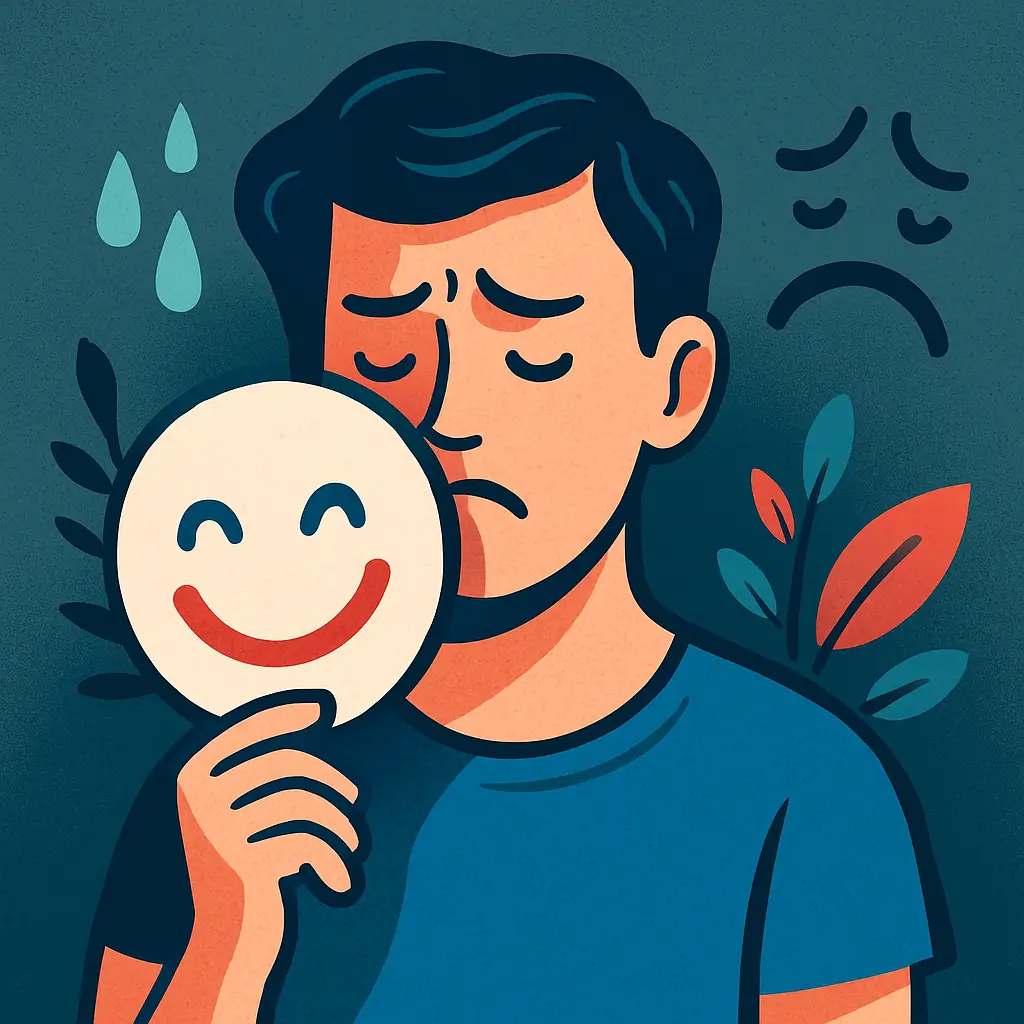
Have you ever smiled for a photo while feeling empty inside? Or said “I’m fine” when you were anything but?
I have. For years, I wore a mask of happiness over intense social anxiety. I wanted to look “normal” while feeling like an imposter in my own life.
The personal story above is shared from the author’s own experience to illustrate the topic. It is not medical advice, and everyone’s experience is different.
Quick answer: Pretending to be happy means showing cheerfulness you don’t actually feel, usually to fit in, avoid judgment, or protect others. A little social masking is normal. But doing it all the time is linked to more stress, weaker relationships, and lower well-being. The way out is to name what you really feel, share it with safe people, and build small daily habits that create genuine happiness instead of a performance.
Key takeaways
- Pretending to be happy is common, but chronic emotional suppression is linked to lower well-being and weaker social connection.
- A posed smile can nudge your mood slightly, but it can’t fix the reasons you’re unhappy.
- Watch for “smile without the eyes,” deflecting with humor, crashing after social events, and big gaps between online and offline life.
- Smiling depression is a real pattern: someone looks fine on the outside while struggling with depression inside. It deserves professional help.
- Authentic happiness comes from habits across your 5 Core Areas of Life: Mindset, Career & Finances, Relationships, Physical Health, and Emotional & Mental Health.
What Does Pretending to Be Happy Mean?
Pretending to be happy is the habit of hiding your real feelings behind a cheerful face, voice, or social media feed. Psychologists call related patterns emotional masking (covering true emotions in social settings) and expressive suppression (holding back the outward signs of what you feel).
It’s important to separate three things:
| Privacy | Pretending to be happy | Authentic expression | |
|---|---|---|---|
| What it looks like | “I’d rather not talk about it right now.” | “I’m great!” (when you’re not) | “Honestly, today’s been rough.” |
| What it protects | Your boundaries | Other people’s comfort and your image | Your connection and your health |
| Long-term cost | Low | High: stress, isolation, numbness | Low, often builds closer relationships |
| When it’s useful | With people you don’t trust yet | Short, high-stakes moments only | With safe, trusted people |
Choosing privacy is healthy. Fake happiness becomes a problem when it’s your default setting, even with the people closest to you.
Why Do People Pretend to Be Happy?
Understanding why you fake happiness is the first step to breaking the pattern. Here are the most common reasons.
1. Society’s relentless positivity pressure
From childhood, many of us learn that sadness, anger, and fear are things to hide or apologize for. “Cheer up.” “Look on the bright side.” “It could be worse.” Over time, normal human emotions start to feel like personal defects.
Social media turns up the pressure by showing everyone’s highlight reel. In a University of Pennsylvania experiment, students who limited social media to about 30 minutes a day for three weeks reported less loneliness and depression than those who used it as usual. Constantly comparing your real life to other people’s curated happiness makes faking it feel necessary.
There’s a healthy kind of positivity, and an unhealthy kind. If you want the healthy version, see our guide on how to be a more positive person without denying real feelings.
2. Fear of judgment and rejection
Sharing struggles feels risky. Will I seem weak? Incompetent? A burden? This fear is strongest at work, where many people worry that honesty will be read as instability.
Research on “surface acting” at work, where employees display emotions they don’t feel, links it to higher emotional exhaustion and burnout. If that sounds familiar, our breakdown of the 12 stages of burnout can help you see where you are.
3. Protecting the people you love
Sometimes faking happiness comes from love. Parents hide worries from kids. Friends hide pain so they don’t “bring the group down.” Partners hide dissatisfaction to avoid conflict.
The intention is kind, but the cost is real. It blocks genuine connection and takes away the chance for others to support you. If a relationship requires you to always look happy, it may be worth asking whether it’s healthy. Our guide on how to heal from a toxic relationship covers the warning signs.
4. The perfection trap
Many people who are always pretending to be happy believe that happiness should be their default state, so any sadness feels like failure. That belief creates even more pressure to fake it.
Ironically, chasing constant happiness can backfire. A study led by Iris Mauss found that people who value happiness very highly can end up feeling less happy, especially when life doesn’t match their expectations. Learning how to stop judging yourself is often the first crack in the mask.
Signs Someone Is Pretending to Be Happy
Short answer: The most common signs someone is pretending to be happy are a smile that doesn’t reach the eyes, deflecting personal questions with jokes, energy crashes after social events, physical stress symptoms, and a big gap between their online image and real-life behavior.
The smile doesn’t reach the eyes
A genuine smile, called a Duchenne smile, uses both the mouth and the muscles around the eyes. Research by Paul Ekman and colleagues found that Duchenne smiles are linked to real positive emotion, while smiles that only involve the mouth often aren’t.
You may also notice flashes of sadness or tension that appear for a second before the cheerful mask comes back.
Avoiding deeper conversations
People faking happiness tend to keep things on the surface. Look for:
- Changing the subject when feelings come up
- Focusing only on other people’s lives, never their own
- Using humor to deflect every personal question
- Avoiding situations that might bring up real emotions
Physical signs of holding it in
Hiding emotions takes effort, and the body often shows it:
- Ongoing fatigue and low energy
- Tension headaches
- Digestive problems
- Poor or irregular sleep
- Tight jaw, neck, and shoulders
In a Stanford-affiliated study, people told to hide their emotions during a conversation had higher blood pressure, and so did their partners, along with less rapport. Pretending doesn’t just cost you; it also changes how connected the other person feels.
A gap between online and offline life
Someone who looks endlessly happy online but seems withdrawn in person may be struggling. Notice big differences between:
- Their social media self and their in-person self
- How they act in groups vs. one-on-one
- Their work persona vs. how they act at home
Energy spikes and crashes
People who are pretending to be happy often seem extra upbeat in public, then crash afterward. Needing a lot of recovery time after every social event can be a sign that keeping up the act is draining them.
How to know if someone is depressed but faking happiness
Sometimes the mask covers more than a bad week. Smiling depression is an informal term for when someone looks happy to others while experiencing depressive symptoms inside. It isn’t an official diagnosis, but its symptoms fall under clinical depression.
Possible signs include:
- Constant “I’m fine” answers that never go deeper
- Changes in sleep, appetite, or energy
- Losing interest in things they used to enjoy
- Hints of hopelessness, often said as a joke
- Pulling away from close friends while staying “on” in public
If you notice these signs in someone, gently check in. Ask open questions, listen without fixing, and encourage professional support. Our guide on how to show empathy has practical ways to start.
If you or someone you know is in crisis or thinking about self-harm, please reach out right away. In the U.S., call or text 988 or visit 988lifeline.org. Outside the U.S., contact your local emergency number or a local crisis line. This article is for general education and is not a substitute for professional mental health care.
Does Pretending to Be Happy Make You Happier?
Short answer: A little, for a moment, but not in the long run.
The Many Smiles Collaboration, a study of nearly 3,900 people across 19 countries, found that posing a smile can slightly improve mood. So “fake it till you make it” isn’t pure myth.
But a small mood bump is not the same as being happy. Hiding emotions over and over is a different story. In research by James Gross and Oliver John, people who habitually suppressed their emotions reported lower well-being, fewer close relationships, and more depressive symptoms.
On the other hand, a UC Berkeley-led study of more than 1,300 adults found that people who accept their negative emotions instead of fighting them had better psychological health months later.
The key difference is awareness:
- Healthy: “I’m nervous, and I’m choosing to smile and focus on what’s going well.”
- Unhealthy: “I’m not allowed to feel nervous, so I’ll pretend I’m not.”
Long-term faking happiness tends to lead to:
- Emotional numbness
- Shallow relationships
- Confusion about what you actually need
- Delaying the real problems that make you unhappy
How to Stop Pretending to Be Happy: 7 First Steps
If you’re tired of pretending to be happy, start small. You don’t need to tell everyone everything tomorrow.
- Name the feeling. Say it in your head or write it down: “I feel anxious,” “I feel lonely.” Research shows that putting feelings into words can calm the brain’s alarm response.
- Find one safe person. Pick someone trustworthy and share one honest sentence.
- Replace “I’m fine” with something true. Try, “I’m having a tough week, but thanks for asking.”
- Notice your triggers. Where do you fake it most? Work? Family? Social media?
- Limit the highlight reel. Cut back on scrolling that makes you feel behind.
- Practice self-compassion. Talk to yourself like you’d talk to a struggling friend.
- Get support when it’s heavy. A therapist or counselor can help if the mask feels permanent.
Self-reflection makes every step easier. Try our guide on how to self-reflect to build the habit.
The 5 Core Areas of Life Approach to Authentic Happiness
Genuine happiness isn’t constant positivity. It comes from balance and honesty across the main parts of your life. Working on the 5 key areas of life builds a foundation where you no longer need fake happiness to get through the day.
1. Mindset Core: Rewire your inner dialogue
Your thoughts set the tone for everything else. Your brain strengthens the thought patterns you repeat, so changing your inner dialogue changes how you feel over time.
Key practices:
- Challenge negative self-talk with evidence
- Treat failures as lessons, not proof of your worth
- Notice your thought patterns without judging them
- Practice self-compassion. In one study, people who used self-compassion after a mistake were more motivated to improve than those who didn’t.
Read more: Abundance vs. Scarcity Mindset
2. Career & Finances Core: Align work with purpose
Work that fits your values creates real engagement. Financial stability gives you room to make choices based on well-being, not fear.
Focus on:
- Knowing your strengths and using them at work
- Making sure your work matches your values
- Building savings to reduce money stress
- Setting boundaries that protect your energy
Read more: Why Can’t Money Buy Happiness?
3. Relationships Core: Build authentic connections
Relationships where you can show both joy and struggle make pretending unnecessary. The Harvard Study of Adult Development, which has followed participants for more than 80 years, points to close relationships as one of the strongest predictors of a happy, healthy life.
Prioritize:
- People you can be fully yourself around
- Honest conversations about real experiences
- Boundaries with people who require your fake happiness
- Friends who also value authenticity
Need help opening up? See how to start a hard conversation.
4. Physical Health Core: Energize your body
When you’re exhausted, it’s much harder to be honest with yourself and others. Movement, sleep, and good food give you the energy to stop performing.
Essential habits:
- Move in ways you enjoy, not as punishment
- Keep a consistent sleep routine
- Eat for steady energy and mood
- Listen to what your body needs
5. Emotional & Mental Health Core: Embrace the full spectrum
Learning to notice, express, and manage emotions, instead of hiding them, is the core skill for breaking free from pretending to be happy.
Focus on:
- Building your emotional vocabulary
- Finding safe outlets for hard emotions
- Learning healthy ways to calm intense feelings
- Getting professional help when you need it
Practical Strategies for Each Core Area
Here are quick, specific strategies you can start this week.
Mindset Core strategies
- Practice mindful awareness. Observe hard emotions without judgment. This gives you space to respond instead of react.
- Build realistic optimism. Swap toxic positivity for “This is hard, and I can handle it.”
- Develop self-compassion. Be as kind to yourself as you’d be to a friend.
Career & Finances Core strategies
- Align work with values. Find small ways to express your values at work.
- Create financial stability. Build an emergency fund and a simple spending plan.
- Pursue mastery over status. Skills that put you in flow satisfy more than titles.
Relationships Core strategies
- Practice honest communication. Start with low-risk shares and build up.
- Curate your circle. Spend more time with people who don’t need you to perform.
- Balance giving and receiving. Let people support you, too. Becoming a better listener makes this two-way.
Physical Health Core strategies
- Move for enjoyment. Pick activities that feel fun.
- Prioritize sleep quality. Rested people regulate emotions better.
- Nourish for energy. Choose foods that avoid big crashes.
Emotional & Mental Health Core strategies
- Expand your emotional vocabulary. Naming feelings precisely, called emotional granularity, is linked to better emotion regulation.
- Create emotional outlets. Journaling, creative work, exercise, or a confidential conversation.
- Develop regulation skills. Breathing, grounding, and pausing help you feel emotions without being swept away.
Using AI to Personalize Your Path to Authentic Happiness
Knowing the theory helps. Applying it to your own life is what changes things. An AI coach can help you find your specific pain points and build habits that fit your routine.
AI prompt to copy and paste
“I want to stop pretending to be happy and build genuine happiness habits. Act as a science-based happiness coach using positive psychology and habit formation research. Guide me step by step, and wait for my answer before moving on.
Step 1: Identify the challenge.
- In which situations do I most often pretend to be happy? (Example: work meetings, family gatherings)
- What am I actually feeling in those moments? (Example: anxiety about being judged)
- How long has this been happening, and when did I first notice it?
Step 2: Map it to my life areas. Tell me which of these areas it affects most: Mindset, Career & Finances, Relationships, Physical Health, or Emotional & Mental Health. Explain how it affects the others, then ask: ‘Does this match your experience?’
Step 3: Suggest habits. Once I confirm, suggest three different habits that could help, suited to different personality types.
Step 4: Personalize my Golden Habit. Ask when in my day it would fit, what resources I have, and what has worked for me before.
Step 5: Build my plan. Give me exact details (when, where, how), why it suits me, how to track progress, and one strategy for my most likely obstacle.”
Read more: What Are Keystone Habits?
Example conversation
The conversation below is an illustrative example, not a real user’s session.
AI: “In which situations do you most often find yourself pretending to be happy?”
User: “At work meetings, especially when I present. I smile and act confident, but I’m terrified inside.”
AI: “What are you actually feeling in those moments?”
User: “Anxiety that I’ll say something wrong and look incompetent.”
AI: “This mainly affects your Mindset Core, specifically your confidence at work. It also ripples out:
- Career Core: It may be holding back your growth and job satisfaction.
- Relationships Core: It makes real connection with colleagues harder.
- Emotional Health Core: It creates ongoing stress and anxiety.
Does this match your experience?”
User: “Yes. I never realized it affected so much.”
AI: “Here are three habits that could help:
- Reflection-based: A daily journal of work wins to build confidence from evidence.
- Skill-based: Short practice presentations in a safe setting to build mastery.
- Support-based: A feedback partnership with a trusted colleague for honest input.
Which one fits you best?”
This kind of back-and-forth gives you advice that fits your life, not generic tips. If you’re ready to make it stick, our guide on how to take action helps you turn the plan into daily progress.
Conclusion: From Fake to Authentic
Stopping pretending to be happy isn’t about feeling positive all the time. It’s about building a life where you can feel and express the full range of human emotions.
That takes courage to admit where you’ve been faking it, compassion for why you needed the mask, and commitment to building something better. Sadness, anger, and fear aren’t obstacles to happiness. They’re part of a full life.
Start with one honest sentence and one small habit. As you build momentum in one Core Area, you’ll notice it spreading to the others. Honest relationships improve your mindset. Better sleep makes emotions easier to handle. That’s how real happiness grows, one step at a time. For a deeper look at what you’re working toward, read what true happiness really is and how to find happiness within yourself.
🚀 What if being genuinely happy felt like pressing start on a game?
The Moore Momentum System makes building authentic happiness simple, science-backed, and AI-personalized. Instead of another boring self-improvement plan, you earn streaks, points, and visible progress across all 5 Core Areas of Life, with a daily check-in that adapts to how you’re actually feeling, not how you’re pretending to feel.
👉 Start with a 60-second win. Take the free Core Values Quiz to get your personalized Momentum Score and discover which Golden Habit will help you trade fake happiness for the real thing.
PRESS START ON YOUR AUTHENTIC HAPPINESS NOW!
🚀🚀🚀 Don’t forget to check out our Resource Arcade 👾🎮 for FREE templates and tools to gamify your habits.
FAQ: Pretending to Be Happy
Why do I fake being happy?
Most people fake being happy to avoid judgment, protect loved ones, fit in at work, or live up to the idea that happiness should be their default. It often starts in childhood, when sadness or anger was discouraged. Noticing where and with whom you do it most is the best first clue to the reason.
Is it normal to pretend to be happy all the time?
Occasional masking is normal, like smiling through a stressful meeting. Pretending to be happy all the time is not healthy. Research links habitual emotional suppression to lower well-being and weaker relationships. If the mask never comes off, even with people you trust, it’s a sign to slow down and get support.
Does fake smiling make you happy?
A little. A large 19-country study found that posing a smile can slightly boost mood in the moment. But it won’t solve the reasons you feel unhappy. Use a smile as a small nudge, not a cover-up, and pair it with honest steps to address what’s really going on.
How do you fake being happy when you’re not?
If you truly need to hold it together, like at a funeral, an interview, or a big presentation, keep it short and plan time afterward to process your real feelings. A healthier option is honest but private: “I’m having a tough day, but I’m glad to be here.” That protects your boundaries without the full performance.
How can I stop pretending to be happy when I’m depressed?
Start by telling one trusted person the truth, even in one sentence. Keep social plans light, look after sleep and food, and reach out to a doctor, therapist, or counselor. Pretending to be happy when depressed can delay the help that works. If you’re in crisis, call or text 988 in the U.S. or your local emergency number.
How do you know if someone is depressed but faking happiness?
Look for patterns, not single moments: constant “I’m fine” answers, changes in sleep or appetite, jokes about hopelessness, losing interest in hobbies, or pulling away from close friends while staying cheerful in public. This is sometimes called smiling depression. Check in gently and encourage professional support.
What are the signs someone is pretending to be happy?
Common signs include a smile that doesn’t reach the eyes, deflecting personal questions with humor, needing lots of recovery time after social events, physical stress like headaches or poor sleep, and a big gap between their online image and real-life mood.
How can I be genuinely happy instead of pretending?
Genuine happiness comes from habits, not performance. Name your feelings, build honest relationships, protect your sleep and energy, align your work with your values, and practice self-compassion. Small daily habits across all 5 Core Areas of Life add up to happiness you don’t have to fake.