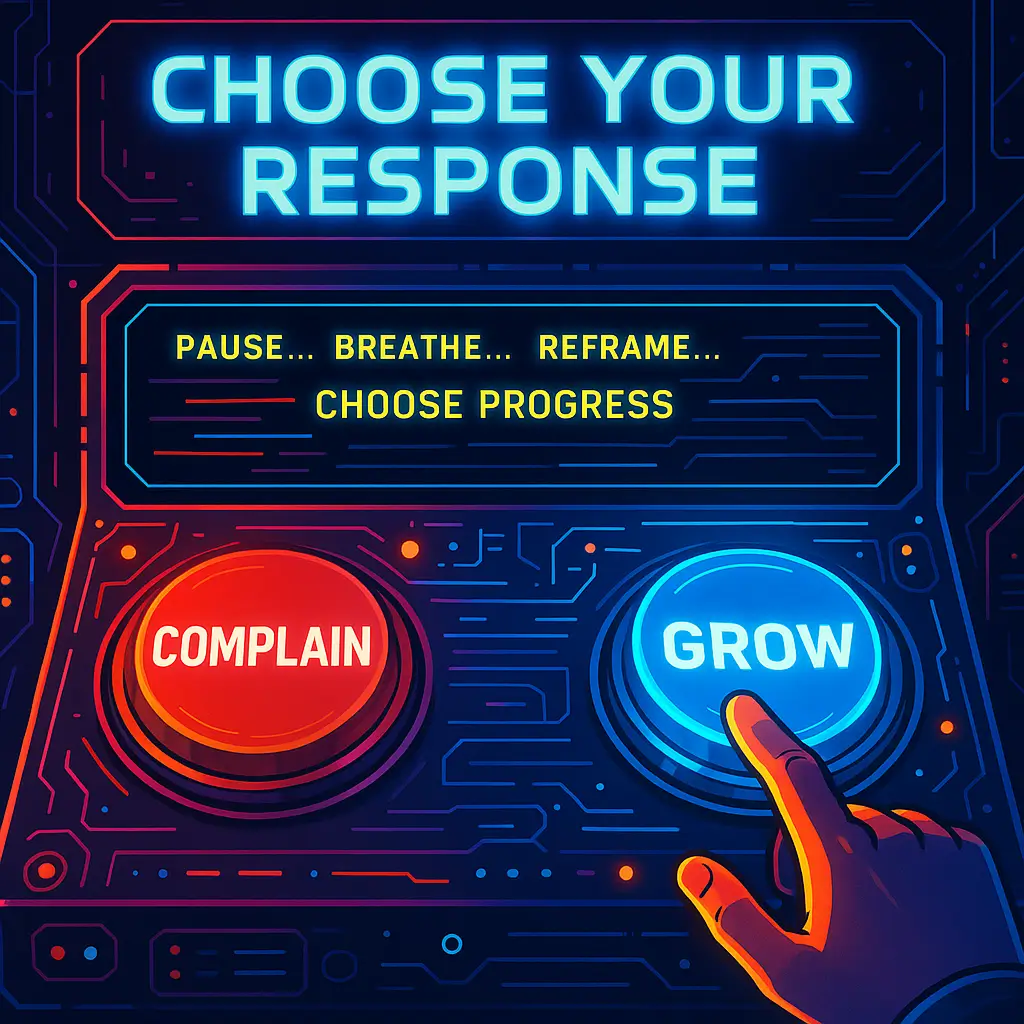
Traffic, coworkers, the weather, the Wi-Fi. For a lot of us, complaining has become background noise. It feels harmless, and sometimes it even feels good. But when complaining turns into a default setting, it quietly shapes your mood, your relationships, and how other people see you.
This guide explains how to stop complaining without pretending everything is fine. You’ll learn why people complain so much, how complaining differs from healthy venting, and nine practical steps you can start today to replace negative talk with habits that actually move your life forward.
Quick answer: To stop complaining, start by noticing when and why you complain. Then turn each complaint into one of three things: a clear request, a possible solution, or something you’re grateful for. Track your complaints for one week, create at least one “complaint-free zone,” and pause before you speak. Expect the change to take weeks, not days. In habit research, new behaviours took an average of 66 days to become automatic.
What Counts as Complaining?
Psychologist Robin Kowalski, whose 1996 review is one of the most cited papers on the topic, defines complaining as an expression of dissatisfaction, used either to release emotion or to achieve a personal or social goal.
That definition matters, because not every complaint is a problem. Researchers separate complaints into two broad types:
- Instrumental complaints aim to change something. (“The invoice is wrong. Can you fix it?”)
- Non-instrumental complaints just express dissatisfaction, with no plan to change anything. (“Nothing ever works around here.”)
When people talk about wanting to stop complaining, they almost always mean the second type: the repetitive, automatic negativity that doesn’t solve anything.
Complaining vs. Venting: What’s the Difference?
Venting and complaining look similar on the surface, but they lead to very different places.
| Healthy venting | Chronic complaining | |
|---|---|---|
| Goal | Process an emotion and move on | Repeat the same frustration |
| Frequency | Occasional, tied to a real event | Daily, often automatic |
| Focus | “This is how I feel” | “This is what’s wrong with everything” |
| Outcome | Relief, clarity, then action | Stuck feelings, no change |
| Effect on others | Builds connection | Drains and pushes people away |
A useful test: after you’ve talked about it, do you feel lighter and clearer, or do you feel more irritated than before? Venting ends. Complaining loops.
Why Do People Complain So Much?
People complain so much because complaining meets real needs. It offers quick emotional release, a way to bond with others, and a sense of control when life feels out of control. The problem is that it meets these needs in the short term while making them harder to meet in the long term.
1. Quick Emotional Relief
Saying a frustration out loud feels good in the moment. It can earn sympathy, validation, and attention, and that small reward makes the behaviour more likely to repeat. Over time, it stops being a reaction and becomes a bad habit triggered by familiar cues.
2. Social Bonding
Shared complaints are an easy way to connect. Coworkers bond over a difficult manager; parents bond over sleepless nights. Kowalski’s research notes that complaining can serve interpersonal goals like gaining sympathy or fitting in. The catch is that relationships built mainly on shared grievances rarely grow deeper.
3. A Feeling of Powerlessness
When people feel they can’t change a situation, complaining becomes a way to express some agency. That’s why someone can complain about the same problem for years without acting on it. The complaint replaces the action.
4. Avoiding Responsibility
Focusing on outside factors protects us from looking at our own part in a problem. It’s often rooted in the fear of failure. If the problem is always “out there,” we never have to risk trying and falling short.
5. The Brain’s Negativity Bias
Humans are wired to notice threats. A well-known review titled “Bad Is Stronger Than Good” found that negative events and information tend to have a stronger psychological impact than positive ones of the same size. Complaining is partly this bias speaking out loud.
Why Do I Complain So Much? 5 Self-Check Questions
If you’re asking “why do I complain so much,” honest self-reflection is the first step. Without awareness, there’s no choice. Use these five questions to understand your own pattern:
- What triggers it? Do you complain more when you’re tired, hungry, stressed, or around certain people?
- What do you really want? Sympathy, validation, a solution, or just to be heard? Naming the need helps you ask for it directly.
- Is it within your control? Complaints about the weather or other people’s choices often hide areas where you do have power.
- Is it a habit or a real concern? Some complaints are automatic openers, the way we reach for our phone when bored.
- Who benefits? If no one is better off after the complaint, including you, it’s probably not serving you.
Answer these honestly for a few days and patterns will appear quickly.
The Hidden Costs of Constantly Complaining
Constantly complaining doesn’t stay in one corner of your life. It spreads across your mindset, career, relationships, and health.
Mindset
What you repeatedly focus on, you get better at noticing. Rehearsing what’s wrong trains your attention toward problems, which makes the next complaint come even faster. It’s a self-reinforcing loop that can leave you feeling lost in life even when nothing is objectively wrong.
Career
Teams value people who bring solutions. Research on emotional contagion in work groups shows that one person’s mood can spread through a team and affect cooperation and performance. A chronic complainer often becomes known as the person who drains the room, which can quietly limit opportunities.
Relationships
Occasional venting brings people closer. Chronic complaining pushes them away. Friends and partners may start avoiding conversations, which can lead to loneliness, which then gives you more to complain about.
Physical Health
Ongoing negativity keeps your stress response switched on. The American Psychological Association explains that chronic stress affects nearly every system in the body, from muscles and digestion to the heart and immune system.
Note: If negativity feels constant, heavy, and hard to shake, and it comes with low mood, poor sleep, or loss of interest in things you used to enjoy, it may be more than a habit. Speaking with a doctor or licensed mental health professional is a good next step.
How to Stop Complaining: 9 Science-Backed Steps
Here is how to stop complaining in a way that lasts. You don’t need to apply all nine at once. Pick two or three, practise them daily, and add more as they become automatic.
Step 1: Track Your Complaints for 7 Days
Most people underestimate how often they complain. For one week, make a quick tally in your notes app every time you complain, and write down the trigger. Measurement alone often reduces the behaviour, because it turns an unconscious habit into a conscious choice.
Step 2: Use the STOP Technique
When you notice a complaint forming, pause and run through this:
- Stop what you’re about to say
- Take one slow breath
- Observe what you’re feeling and why
- Proceed with something useful: a request, a solution, or nothing at all
This creates a gap between trigger and reaction, and that gap is where change happens.
Step 3: Name the Feeling Instead of Blaming the Situation
Instead of “This meeting is pointless,” try “I’m frustrated because I feel my time isn’t being used well.” A UCLA brain-imaging study found that putting feelings into words reduced activity in the amygdala, the brain’s alarm centre. Naming the emotion calms it. Blaming the world tends to inflame it.
Step 4: Turn Every Complaint Into a Request or a Solution
Ask yourself: “What would I like to happen instead?” Then say that.
| Complaint | Replacement |
|---|---|
| “You never help around the house.” | “Could you handle the dishes on weeknights?” |
| “This traffic is the worst.” | “I’ll leave 15 minutes earlier tomorrow and use this time for a podcast.” |
| “My boss never gives feedback.” | “I’ll ask for a 10-minute check-in on Friday.” |
This keeps the legitimate concern and drops the negativity.
Step 5: Apply the “Three Before Me” Rule
Before complaining about someone else’s behaviour, list three things you could do differently to improve the situation. This shifts you from a victim mindset to an owner mindset and usually reveals more control than you expected.
Step 6: Practise Gratitude on Purpose
Gratitude is the most researched counterweight to complaining. In a well-known study by Emmons and McCullough, people who wrote down things they were grateful for each week reported feeling better about their lives and more optimistic than people who recorded hassles. Try listing three specific good things each evening, or pick one of these fun gratitude activities for adults.
Step 7: Create Complaint-Free Zones
Choose specific times or places where complaining is off-limits, like family dinners, the first hour of your workday, or your bedroom. Small, clear boundaries are easier to keep than a vague promise to “be more positive.”
Step 8: Try a 21-Day No-Complaining Challenge
Pastor Will Bowen’s Complaint Free World challenge asks participants to wear a bracelet and switch it to the other wrist each time they complain, criticise, or gossip, restarting the count each time. The goal is 21 days in a row. Most people take months to finish, which says a lot about how automatic the habit is. You can do the same with a rubber band, a ring, or a habit-tracking app.
Step 9: Replace the Habit, Don’t Just Remove It
Old habits don’t disappear; new ones just need to become stronger. Pair each common complaint trigger with a specific replacement:
- Complaining about your commute → queue an uplifting podcast before you leave
- Complaining about work stress → take a two-minute breathing break
- Complaining to a friend → ask them a curious question about their day instead
Building one positive routine often creates a ripple effect across others. That’s the idea behind keystone habits.
Example (illustrative): Sara, a project manager, tracked her complaints for a week and counted 40, most of them in the first hour at work. She made her morning commute a complaint-free zone and replaced her usual grumbling with a quick list of three things she wanted to get done that day. By the end of the month, her daily count had dropped to single digits.
Disclaimer: This is a composite example created for illustration. Names and details are not from a real individual, and results will vary.
How to Stop Complaining at Work and in Relationships
Knowing how to stop complaining in specific settings makes the steps easier to apply.
At work: Bring a possible solution every time you raise a problem, even a rough one. Keep complaints about colleagues out of group chats, and take real issues directly to the person or manager who can fix them.
In relationships: The key to how to stop complaining in a relationship is to replace “you always” and “you never” with a specific, kind request. Agree on a short daily check-in where each person can share one frustration and one appreciation. Couples who keep criticism specific and balanced with appreciation tend to feel more connected.
How to Deal With a Chronic Complainer
Sometimes the problem isn’t you; it’s the constantly complaining person next to you. A few approaches help:
- Acknowledge, then redirect. “That sounds frustrating. What do you think you’ll do about it?”
- Don’t try to fix everything. Chronic complainers often want to be heard, not solved.
- Set gentle limits. “I’m happy to listen for a few minutes, then let’s talk about something else.”
- Model the change. People tend to mirror the emotional tone around them.
How Long Does It Take to Stop Complaining?
Popular advice says 21 days, but research suggests longer. In a study at University College London, participants took an average of 66 days for a new behaviour to become automatic, with a wide range of 18 to 254 days. The same research found that missing an occasional day didn’t derail progress.
So if you’re learning how to stop complaining, think in months, not weeks, and don’t quit after a slip. You can also use a structured approach like the 21/90 rule for habit transformation to pace yourself, and strengthen your follow-through with these tips on how to build discipline and consistency.
Conclusion: How to Stop Complaining for Good
Learning how to stop complaining isn’t about ignoring real problems or forcing fake positivity. It’s about noticing your patterns, naming what you actually feel, and turning frustration into requests, solutions, and gratitude.
Start small. Track your complaints for a week, choose one complaint-free zone, and practise one replacement habit every day. Every time you choose a solution over a complaint, you strengthen a more positive default. If you’ve drifted off course, this guide on how to get your life back on track is a good next read.
🚀 What If Breaking Your Complaining Habit Felt Like Pressing Start on a Game?
The Moore Momentum System makes personal growth simple, science-backed, and AI-personalized. Instead of relying on willpower, you earn streaks, points, and visible progress across all 5 Core Areas of Life, with a daily check-in that adapts to you, so swapping complaints for positive habits feels like levelling up, not a chore.
👉 Start with a 60-second win. Take the free Core Values Quiz to get your personalized Momentum Score and discover which Golden Habit will help you shift from complaining to creating.
PRESS START ON YOUR POSITIVE MINDSET NOW!
🚀🚀🚀 Don’t forget to check out our Resource Arcade 👾🎮 for FREE templates and tools to gamify your habits.
FAQs About How to Stop Complaining
How to stop complaining so much?
To stop complaining so much, track your complaints for a week to see your triggers, then replace each complaint with a request, a solution, or a gratitude statement. Use a pause technique like STOP before you speak, and set at least one complaint-free zone in your day.
Why do I complain so much?
You may complain so much because it brings quick emotional relief, helps you bond with others, or gives you a sense of control when you feel powerless. Stress, tiredness, and the brain’s natural negativity bias also make complaining more likely.
Why do people complain so much?
People complain so much because complaining meets short-term needs like sympathy, validation, and connection. Over time, it becomes an automatic habit triggered by familiar situations, even when it no longer helps.
Why do I constantly complain?
Constantly complaining is usually a habit loop: a trigger (stress, boredom, a certain person), a complaint, and a small reward (attention or relief). If it comes with persistent low mood, it’s worth talking to a mental health professional.
What is the difference between complaining and venting?
Venting is occasional and helps you process an emotion and move on. Complaining is repetitive, focuses on what’s wrong, and usually leaves you feeling worse rather than lighter.
How do you deal with someone who complains all the time?
Acknowledge their feelings, then gently redirect with a question like “What do you think you’ll do about it?” Set limits on how long you’ll listen, avoid trying to fix everything, and model positive language yourself.
What is the no complaining rule?
The no complaining rule is a commitment to stop non-productive complaints, often for a set period. A popular version is the 21-day Complaint Free challenge, where you switch a bracelet to the other wrist each time you complain and restart your count.
How long does it take to stop complaining?
It usually takes several weeks to a few months. Research from University College London found new habits took an average of 66 days to become automatic, ranging from 18 to 254 days.
Is complaining bad for your health?
Occasional complaining is normal and can even help you process emotions. Chronic complaining is different: it keeps your stress response switched on, and ongoing stress affects sleep, digestion, the heart, and the immune system.