Imagine this: You’re about to raise your hand in the meeting, apply for the promotion, or finally start the side project you’ve been dreaming about. And then a voice in your head whispers, “Who do you think you are?”
You put your hand down, close the browser tab. You wait for “someday.”
Sound familiar? You’re not alone. Research published in the Journal of General Internal Medicine found that impostor syndrome — the persistent belief that you’re a fraud despite real evidence of competence affects up to 70% of people at some point in their lives. It’s a chronic undercurrent of self-doubt that keeps millions stuck in a Failure Loop, playing smaller than they’re capable of.
The brutal truth? If you don’t believe in yourself, no amount of talent, opportunity, or hustle will get you where you want to go. Self-belief isn’t a nice-to-have. It’s the foundation of every goal you’ll ever achieve.
The good news: believing in yourself is a skill — not a personality trait you’re either born with or not. And with the right AI-powered system, you can build it faster, smarter, and with far less friction.
By the end of this article, you’ll have:
- A clear answer to why you don’t believe in yourself (and why it’s not your fault)
- 5 science-backed, AI-enhanced steps to rebuild self-confidence from the ground up
- A personalized system to make believing in yourself automatic — not an ongoing battle of willpower
Let’s level up. 🚀
What Does It Mean to Believe in Yourself?
Believing in yourself means trusting that you have the capacity to grow, adapt, and overcome challenges even when the outcome isn’t guaranteed. It doesn’t mean thinking you’re perfect. It means adopting what psychologist Carol Dweck calls a growth mindset: the belief that your abilities aren’t fixed. And that effort, strategy, and learning are the engines of progress.
In short, having faith in yourself is the difference between saying “I can’t do this” and saying “I can’t do this yet.”
Why Don’t I Believe in Myself?
Why don’t I believe in myself — even when I know better?
The answer lives in your brain’s wiring. Every time you’ve failed, been criticized, or compared yourself to someone else’s highlight reel, your neural pathways reinforced a story: I’m not good enough. Do that enough times and it becomes automatic — a mental habit running in the background 24/7.
The culprits are familiar: comparison culture, impostor syndrome, perfectionism, and a fear of failure baked in by school systems that punish mistakes. These aren’t character flaws. They’re the predictable output of misguided default systems most of us never chose.
The fix isn’t a motivational quote. It’s rewiring the habit loop using proven behavioral science and AI personalization to replace your self-doubt script with one that actually serves you.
5 AI-Powered Steps to Believe in Yourself (and Always Believe in Yourself Going Forward)
Step 1: Identify Exactly Where Your Self-Doubt Lives
You can’t fix what you can’t see.
Most people treat self-doubt as one big, shapeless cloud. But self-doubt is specific. It might show up in your career, your relationships, your physical appearance, or your ability to follow through. Pinpointing the exact pain point is the first step in the Moore Momentum System’s Habits Hierarchy. An AI-powered process that maps your self-doubt to its root Core Area, so you’re solving the actual problem, not a symptom.
Try this AI prompt to get started:
“I struggle to believe in myself in the following area: [describe your situation]. Based on this, what are the most likely root causes of my self-doubt, and what is one small, science-backed habit I could build to start addressing it? Consider my lifestyle: [age, job, daily routine], my strengths: [list 2-3], and my passions: [list 2-3].”
The more personal context you give the AI, the more precise — and actionable — the output. This is the opposite of the one-size-fits-all advice you’ve probably already tried and abandoned.
Read More: How to Stop Judging Yourself
Step 2: Build Your “Golden Habit” for Self-Belief
Once you know where your self-doubt lives, it’s time to identify your Golden Habit. The one personalized action that directly targets that pain point and starts to rewire your inner script.
For self-confidence and positive self-talk, research consistently points to one of the most effective and underrated tools: a daily personal mantra or affirmation practice. Psychologist Claude Steele’s self-affirmation theory, supported by decades of studies, shows that regularly affirming your core values reduces the psychological threat response that fuels self-doubt — and can meaningfully shift how you see yourself over time.
But here’s what makes this different from generic advice: your mantra needs to be yours. Not a copied Pinterest quote. Not something that feels fake when you say it.
AI Prompt:
“Help me create a personal daily mantra to build self-belief that feels authentic to me. Here are my core values: [list 2-3]. Here are the negative thoughts I most commonly have about myself: [list them]. Make the mantra short, powerful, and something I could say during my morning routine.”
This is your Golden Habit: a personalized, 60-second morning mantra said aloud during your shower or morning stretch — low friction, high impact.
Step 3: Make Self-Belief Obvious and Attractive (MBM #1)
A habit you don’t see is a habit you won’t do.
Momentum Boosting Method #1 — Make it Obvious/Attractive — is about engineering your environment so your self-belief habit is impossible to miss and emotionally compelling to start.
Practical moves:
- Write your mantra on a sticky note on your bathroom mirror
- Set a phone alarm labeled “I believe in myself — say it now” at the same time each morning
- Change your phone wallpaper to your mantra or a reminder of a past win
These aren’t tricks. They’re the application of what USC researcher Wendy Wood found. Approximately 40% of our daily behaviors are environmentally triggered — automatic responses to familiar cues, not conscious choices. Change your environment, change your behavior.
AI Prompt:
“Based on my morning routine [describe it briefly], suggest 3 specific ways I could make my daily mantra habit more visible and attractive so I don’t forget it or skip it.”
Step 4: Make It Easy (MBM #2)
Willpower is a finite resource. Friction is the enemy of consistency.
Momentum Boosting Method #2 — Make it Easy — uses habit stacking: anchoring your new self-belief habit to something you already do automatically.
The formula: “After I [CURRENT HABIT], I will [NEW GOLDEN HABIT].”
Example: “After I turn on the shower, I will say my morning mantra three times aloud.”
Stanford behavioral scientist BJ Fogg found that anchoring new behaviors to established ones dramatically increases follow-through. Because you’re piggybacking on an existing neural pathway instead of building a new one from scratch. His research with over 40,000 participants confirms that starting small and linking to existing routines is the most reliable path to lasting habit change.
AI Prompt:
“Here are my current morning habits: [list them]. Help me use habit stacking to attach my daily self-belief mantra to the most logical existing habit in my routine so it takes zero extra time or effort.”
Step 5: Make It Fun and Rewarding (MBM #3)
How to believe in yourself again after repeated setbacks? You need dopamine on your side.
Momentum Boosting Method #3 — Make it Fun/Rewarding — is about creating an immediate positive feeling after your self-belief habit, so your brain starts to crave it.
Options:
- Follow your mantra with 60 seconds of your favorite song (temptation bundling)
- Track your streak in a habit tracker and celebrate hitting 7, 14, and 21 days
- Share a weekly self-belief win with one trusted friend or accountability partner
The Moore Momentum System’s gamified platform takes this further. Turning your daily wins into momentum points, streaks, and real progress across your Mindset Core, so the dopamine hit comes not just from the habit, but from visibly leveling up in the game of life.
Real-World Example: How Jordan Used AI to Rebuild His Self-Belief
Jordan, 26, a software engineer, knew he was talented. However, impostor syndrome kept him from speaking up in meetings or pursuing a senior role.
Using the AI prompts above, he identified his pain point (Career Core self-doubt), built a Golden Habit (a 60-second morning mantra: “I solve hard problems. I’ve earned my seat at this table.”), and stacked it onto his existing coffee-making routine.
He added a sticky note to his coffee maker (MBM #1), used habit stacking to automate it (MBM #2), and rewarded himself with one episode of his favorite podcast on his commute after completing it (MBM #3).
By week three, Jordan volunteered to lead a project presentation. By week six, he submitted his application for the senior role.
He didn’t wake up one day magically confident. He built it — one small, intentional habit at a time.
The Equation Behind It All
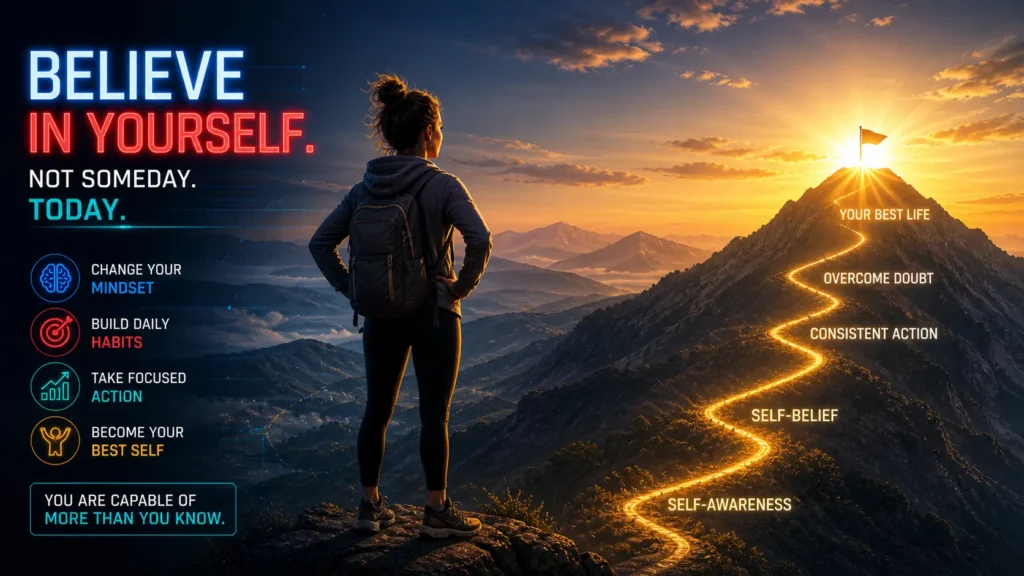
The Moore Momentum System is built on one foundational truth: Your Belief System + Your Repeated Actions + Time = Who You Will Become.
If you don’t believe in yourself, the equation is working against you. The five steps above flip the equation — updating your belief system, reducing friction on the right actions, and giving time the compound interest it needs to transform what you do into who you are.
First it’s a habit. Then it’s your identity. Then it’s simply who you are.
🚀 YOUR AI-POWERED SELF-BELIEF SYSTEM IS ONE CLICK AWAY
You’ve just learned the why and the how behind believing in yourself — backed by science, powered by AI, and built to actually stick.
But knowing the steps and having a personalized system built around your unique strengths, pain points, and lifestyle are two very different things.
The strategies above come directly from the AI-powered Moore Momentum System — a gamified, science-backed platform that doesn’t just tell you what to do, but personalizes every step based on who you actually are.
👉 Take the AI-powered Core Values Quiz to instantly reveal which of your 5 Core Areas is silently draining your momentum — and get a custom AI Momentum Map that shows you exactly where to focus first.
It takes under 60 seconds. The results are immediate. And the clarity it delivers? Game-changing.
Unlock your personalized AI roadmap NOW!
🚀🚀🚀 Don’t forget to check out our RESOURCE ARCADE 👾🎮 for FREE templates and tools to gamify your habits.
FAQs on Believing in Yourself
What does it mean to believe in yourself?
Believing in yourself means trusting your capacity to grow, learn, and adapt — not thinking you’re perfect, but embracing a growth mindset that treats obstacles as temporary and failure as feedback. It’s a learnable skill, not an innate trait.
How do I believe in myself again after failure?
Start small. Use AI to identify your specific self-doubt trigger, build one personalized Golden Habit (like a daily mantra), and stack it onto an existing routine. Small wins compound into lasting self-confidence over time.
Why don’t I believe in myself even when I know better?
Because self-doubt is a deeply ingrained neural habit, not a character flaw. Environmental triggers, comparison culture, and past failures have wired your brain for doubt. The good news: habits can be rewired — especially with AI-personalized methods that reduce friction and make self-belief automatic.