
I’ll never forget sitting in the Rollins College library at rock bottom, feeling like the world’s biggest outcast. Every conversation felt like a minefield. I’d interrupt, talk over people, or zone out while mentally rehearsing what I’d say next. Then I found a book that changed everything: How to Win Friends and Influence People by Dale Carnegie.
One principle hit me like a lightning bolt: “You can make more friends in two months by becoming interested in other people than you can in two years by trying to get other people interested in you.”
The next day at lunch, instead of desperately trying to prove myself to the “cool kids,” I asked questions. Real questions. And then—here’s the revolutionary part—I actually shut up and listened to their answers.
Within weeks, everything shifted. The same people who’d avoided me started seeking me out. Why? Because I’d discovered what good listeners know: people don’t remember what you said—they remember how you made them feel heard.
If you’ve ever wondered how to be a better listener, you’re not alone. In our hyperconnected world, we have more ways to communicate than ever, yet genuine listening has become rare. We zone out during conversations, mentally prepare our responses while others speak, and check our phones mid-sentence. The cost? Missed opportunities, shallow relationships, and the nagging feeling that we’re somehow failing at human connection.
Here’s what you’ll learn:
- 🎯 Why most people struggle with listening (and it’s not your fault)
- 🧠 Five proven strategies that transform your conversations
- 📈 How to build listening into an automatic habit
The Science of Listening: Why Most People Struggle
To become a better listener, focus on three core components: receiving information without judgment, processing what’s being said both emotionally and intellectually, and responding with genuine empathy. Research shows that good listeners use active attention strategies to overcome the brain’s natural tendency to plan responses while others speak.
What Makes a Good Listener?
According to research from Harvard Business Review, effective listeners share four key characteristics: they create a safe environment for dialogue, they ask questions that promote discovery and insight, they periodically summarize what they’ve heard, and they make suggestions without hijacking the conversation.
But here’s the challenge: being a good listener isn’t just about technique—it’s about overcoming biology.
Your brain processes words at 400-500 words per minute, but most people speak at only 125-150 words per minute. That gap creates mental “downtime” where your mind wanders, plans responses, or gets distracted by your phone.
Add our digital environment to the mix—constant notifications, multitasking expectations, shortened attention spans—and you have the perfect storm for poor listening.
Why Is It Important to Be a Good Listener?
The stakes are higher than you think. A study in the Journal of Research in Personality found that perceived listening quality was the strongest predictor of relationship satisfaction—even stronger than the number of activities couples did together.
In professional contexts, research by Accenture revealed that good listeners are 40% more likely to be promoted to leadership positions. Why? Because listening builds trust, facilitates collaboration, and makes people feel valued—the foundation of effective leadership.
On a personal level, feeling heard literally changes our brain chemistry. When someone truly listens to us, our stress hormones decrease and oxytocin (the bonding hormone) increases, creating a neurological reward that strengthens our connection to that person.
Read More: 15 Questions to Discover Your Life Purpose
Understanding the Types of Listening
Before you can improve your listening, you need to understand the types of listening and which situations call for each approach.
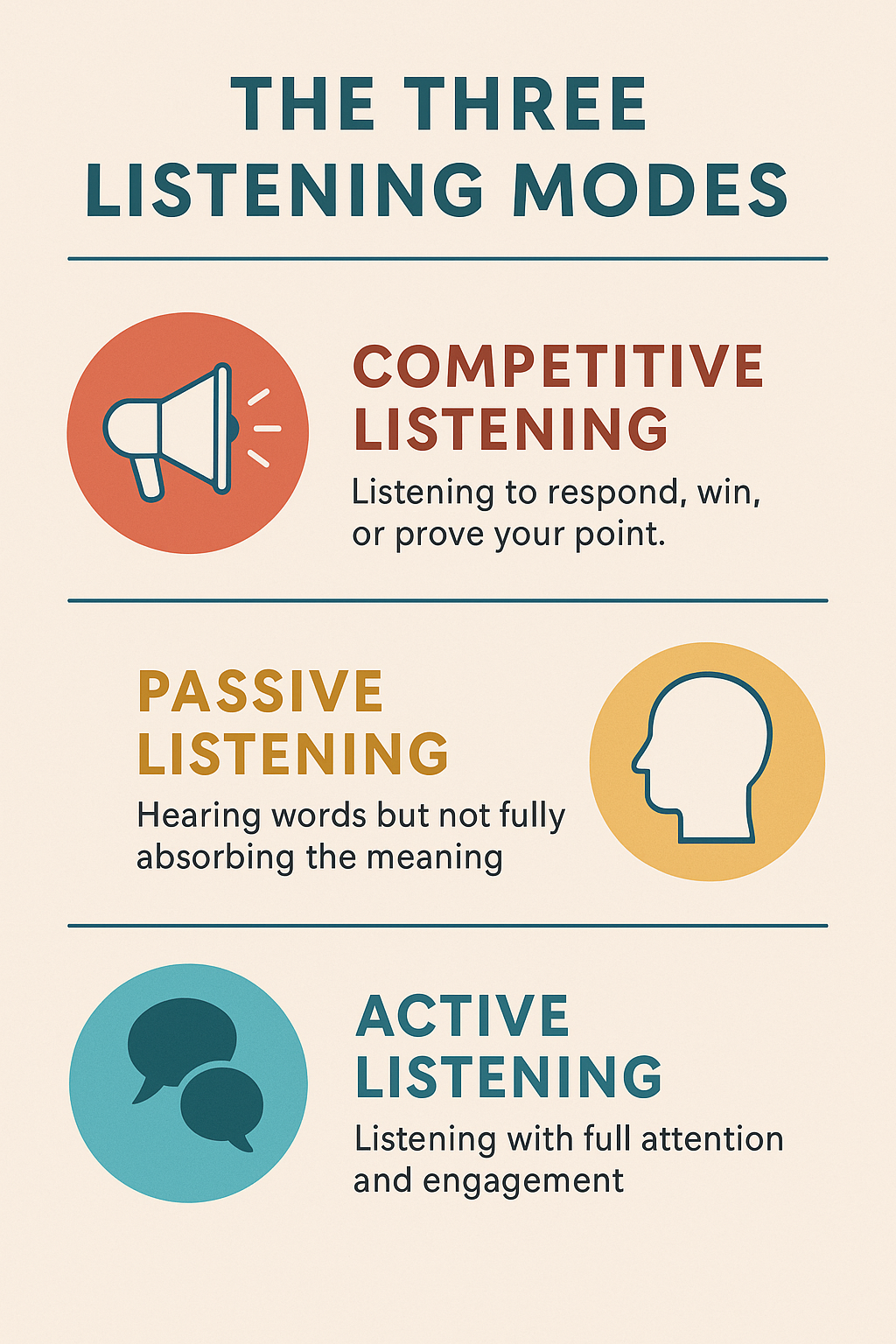
The Three Listening Modes
1. Competitive Listening (What to avoid)
This is listening to respond, win, or prove your point. You’re not absorbing what the other person says—you’re waiting for your turn to talk. Common in debates and arguments, competitive listening destroys connection and makes the other person feel unheard.
2. Passive Listening (The middle ground)
Passive listening means hearing without full engagement. You’re absorbing surface information but not deeply processing the emotional subtext or meaning. It’s common in casual contexts—like half-listening to a podcast while cooking—but it’s insufficient for meaningful relationships.
3. Active Listening (The goal)
Active listening is full presence and engagement. You’re not just hearing words—you’re processing meaning, reading emotional cues, and responding with genuine understanding. This is the foundation for deep connection and the skill we’ll focus on building.
What Are the Three Components of Active Listening?
Active listening breaks down into three essential components:
Component 1: Receiving This means giving your complete attention. It involves maintaining appropriate eye contact, orienting your body toward the speaker, eliminating distractions (yes, that means putting your phone away), and using nonverbal cues like nodding to show engagement.
Component 2: Understanding Processing isn’t just intellectual—it’s emotional. You’re seeking to grasp not just what someone is saying, but why they’re saying it and how they feel about it. This requires empathy, patience, and the willingness to ask clarifying questions rather than making assumptions.
Component 3: Responding What is the last step of active listening strategy? Responding with genuine understanding. This doesn’t mean giving advice or sharing your own story—it means reflecting back what you heard, validating their feelings, and asking thoughtful follow-up questions that show you were truly present.
How to Be a Better Listener
Now that you understand what makes a good listener, let’s build the specific habits that will transform how to be a better listener in your daily life.
1. Create a Distraction-Free Environment
The Problem: Your environment constantly sabotages your attention. Phones buzz, notifications ping, and your mind tracks every movement in your peripheral vision.
The Solution: Design your physical space to support presence.
Immediate Actions:
- Phone Protocol: When someone starts talking, physically place your phone face-down or in another room. Even the sight of your phone reduces conversation quality by 20%, according to University of Essex research.
- Body Orientation: Turn your entire body toward the speaker, not just your head. This physical commitment signals engagement and helps your brain focus.
- Remove Visual Distractions: If you’re in a coffee shop, sit facing away from the door. At home, turn off the TV. In your office, close unnecessary browser tabs.
- The “Closed Laptop” Rule: In meetings, close your laptop unless actively taking notes. The barrier it creates—both physical and psychological—diminishes connection.
Why It Works: Your attention follows your environment. By eliminating competing stimuli, you make listening the path of least resistance.
Start Small: Choose one recurring conversation type (morning coffee with your partner, weekly team meetings, dinner with family) and commit to zero distractions during that specific time.
Read More: What are Digital Habits
2. Master the 3-Second Pause
The Problem: You interrupt or respond before the other person has truly finished. This happens because your brain forms responses faster than people speak, creating the illusion you’ve heard everything you need to hear.
The Solution: Force a deliberate gap between their last word and your first.
How to Implement:
- Count Silently: When someone stops talking, count “one Mississippi, two Mississippi, three Mississippi” in your head before responding.
- Breathe: Take one complete breath—in through your nose, out through your mouth—before speaking.
- Ask Yourself: “Did they actually finish, or just pause?” Many people pause mid-thought. Your silence gives them space to continue.
- Notice the Shift: That 3-second pause feels eternal to you but natural to the speaker. It signals that you’re processing, not just waiting.
Why It Works: The pause serves three functions: it confirms they’re finished, it gives you time to actually absorb what was said, and it communicates respect.
The Speaker-Listener Technique: For difficult conversations, try this structured approach: One person speaks for 2-3 minutes while the other ONLY listens. Then the listener reflects back what they heard before responding. This speaker-listener technique prevents interruption and ensures genuine understanding.
Start Small: Practice the 3-second pause with one person today. Notice how much more you actually hear when you give their words time to land.
Read More: How to Be Productive
3. Replace Advice with Curiosity
The Problem: When someone shares a problem, your instinct is to solve it. But most people don’t want solutions—they want to be heard and understood.
The Solution: Ask follow-up questions instead of offering advice.
The Framework:
- “Tell me more about that.” The single most powerful phrase for deepening any conversation.
- “How did that make you feel?” Shifts from facts to emotions, where real connection happens.
- “What was the hardest part?” Invites them to go deeper into their experience.
- “What do you wish had happened differently?” Helps them process without you imposing your solutions.
- “What support do you need right now?” If they DO want advice, they’ll tell you.
The 3-Question Rule: Ask at least three follow-up questions before offering any advice, opinion, or sharing your own story.
Why It Works: Questions communicate “I’m interested in YOUR experience” while advice communicates “Here’s what I would do.” One builds connection, the other creates distance.
Watch For: “Well, what I would do is…” or “Have you tried…” or “Something similar happened to me…” These phrases shift attention away from them and onto you.
Start Small: In your next conversation where someone shares a problem, ask three curious questions before saying anything else. Notice how the conversation deepens.
4. Reflect and Validate Before Responding
The Problem: People don’t feel heard even when you listened because you jumped straight to your response without acknowledging what they said.
The Solution: Mirror back what you heard before adding your thoughts.
The Reflection Formula:
- Summarize the content: “So what I’m hearing is…”
- Name the emotion: “And it sounds like you’re feeling [frustrated/excited/overwhelmed]…”
- Confirm accuracy: “Did I get that right?”
- Then respond: Only after they confirm, offer your thoughts.
Examples:
Instead of: “My boss gave all the credit for my project to someone else.” “That’s terrible! You should talk to HR.”
Try: “My boss gave all the credit for my project to someone else.” “So you did the work, but someone else got recognized for it. That sounds incredibly frustrating and unfair. Did I understand that correctly?” [Wait for confirmation] “What are you thinking about doing?”
Why It Works: Reflection proves you heard both the facts AND the feelings. It creates psychological safety—the foundation of trust—because the person feels truly seen.
The Validation Checkpoint: Before offering solutions, ask: “Do you want me to just listen, or would you like suggestions?” This simple question prevents the common mistake of “solving” when someone just needed to vent.
Start Small: Practice with low-stakes conversations first. “So you’re saying you prefer the blue design because it feels more modern?” Build the muscle before using it in emotionally charged moments.
Read More: Self-Reflection Questions for Growth
5. Build “Listening Anchors” into Your Day
The Problem: Good intentions fade. You decide to “listen better” but forget in the moment because habits require consistent cues.
The Solution: Stack listening behaviors onto existing habits through specific triggers.
Habit Stacking Formula: “After/When [existing habit], I will [listening behavior]”
Examples:
Morning Routine Anchor: “When I pour my morning coffee, I will ask my partner one meaningful question and listen fully to their answer before checking my phone.”
Work Meeting Anchor: “When I sit down for a meeting, I will close my laptop, put my phone face-down, and take one deep breath before anyone speaks.”
Family Dinner Anchor: “When we sit down to dinner, I will ask each person one thing about their day and maintain eye contact while they answer.”
Phone Call Anchor: “When someone calls me, I will stop what I’m doing, find a quiet spot, and give them my complete attention.”
Conflict Anchor: “When I feel myself getting defensive, I will pause for three seconds and ask ‘What am I missing about how they’re feeling?'”
The Evening Review: Create a 30-second reflection habit: “Before bed, I’ll identify one conversation today where I listened well and one where I could improve.” This builds self-awareness without judgment.
Why It Works: Anchoring listening to existing habits removes the need for willpower. The trigger automatically cues the behavior, making good listening inevitable rather than aspirational.
Track Your Progress: Keep a simple tally. Each day, mark whether you executed your listening anchor. After 21 days, the behavior becomes automatic.
Start Small: Choose ONE listening anchor that fits your life. Master that before adding more. Remember: one habit done consistently beats five habits done occasionally.
Read More: Stop Failing at Life
How AI Can Personalize Your Listening Journey
While the five strategies above work for everyone, AI can accelerate your progress by tailoring the approach to your specific challenges.
Think of AI as a personalized listening coach that helps you identify YOUR unique blind spots. Maybe you listen well when calm but terribly when stressed. Or you’re great one-on-one but zone out in groups. Or you interrupt when excited but withdraw when criticized.
AI can help you:
- Diagnose your patterns: “I struggle with listening during [specific situation]. Help me understand why and create personalized strategies.”
- Practice scenarios: “Give me a practice conversation where someone is sharing a problem. Evaluate whether my response showed true listening.”
- Track improvement: “Design a simple system to measure my listening progress that fits my personality.”
- Build micro-habits: “What’s the smallest possible listening habit I can start today that will build toward mastery?”
The beauty of AI isn’t replacing human connection—it’s helping you become more intentionally present in your real relationships by understanding yourself better.
Real-World Transformation: From Distracted to Deeply Connected
Meet Jordan, a 27-year-old marketing manager who realized she was “hearing but not listening.”
Her wake-up call came during a quiet dinner when her partner said, “You haven’t looked up from your phone once during this entire story.” Jordan felt defensive—she’d heard everything, hadn’t she? But the hurt in her partner’s eyes told a different story.
At work, her team had stopped bringing her problems. A colleague finally told her: “You always seem like you’re waiting for us to finish so you can get back to what you were doing.”
Jordan started with Strategy #1: creating a distraction-free environment. She bought a charging station for the kitchen counter and committed to one rule: phone stays there during dinner conversations.
Week one was harder than expected. Her hand reached for her phone automatically. She felt anxious without it. But she stayed committed.
By week two, she added Strategy #2: the 3-second pause. She caught herself interrupting her partner mid-sentence and forced herself to count to three before responding. “It felt like an eternity,” she said. “But when I stayed quiet, my partner shared things I never would have heard if I’d jumped in.”
Week three brought Strategy #3: replacing advice with curiosity. When a team member came to her with a problem, Jordan’s instinct was to immediately offer solutions. Instead, she asked: “Tell me more about that.” Then: “What’s been the hardest part?” Then: “What support would be most helpful?”
The team member looked stunned. “That’s the first time anyone’s asked me that.” The conversation lasted 20 minutes, and by the end, they’d solved the problem together—with Jordan mostly listening.
The Results of Being a Good Listener
Two months later, her partner said something that made her tear up: “It feels like you’re actually WITH me now. Like you care about my words, not just waiting for your turn.”
At work, the shift was tangible. Team members started seeking her out for advice again. Three months in, she was promoted to team lead. Her manager’s feedback: “Your collaboration skills and ability to make people feel heard have been exceptional.”
But the deepest change was internal. Jordan discovered that listening wasn’t about sacrifice—it was about connection. Each conversation where she stayed fully present left her feeling more energized, not drained. She’d replaced the anxiety of constantly performing with the peace of being genuinely curious about others.
“I thought I was good at multitasking,” Jordan reflected. “But I was actually just doing everything poorly. When I committed to being fully present for one conversation at a time, everything improved—my relationships, my work, even my stress levels. I wasn’t more busy, I was more there.”
Read More: How to Get Out of Your Comfort Zone
🚀 YOU’VE LEARNED THE STRATEGIES — NOW LET AI PERSONALIZE THEM FOR YOUR LIFE
The listening techniques you just discovered are part of the AI-powered Moore Momentum System—designed to transform not just your conversations, but all 5 Core Areas of your life.
Take our 60-second Core Values Quiz to discover which relationship patterns are holding you back and receive personalized AI recommendations for your next Golden Habit in communication and connection.
You’ll get an instant Momentum Score showing exactly where to focus for maximum impact across your relationships, career, health, and mindset.
Unlock your personalized roadmap NOW!
🚀🚀🚀 Don’t forget to check out our RESOURCE ARCADE 👾🎮 for FREE templates and tools to gamify your habits.